A tiny ‘new’ option in one of the food delivery app’s delivery choices recently sparked a healthy debate on one of the leading social media platforms.
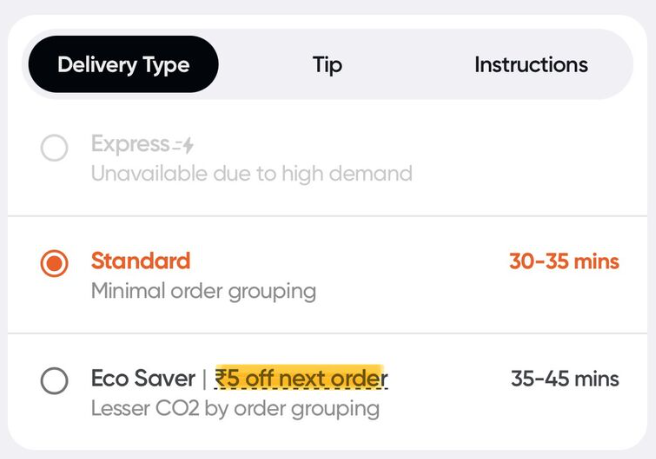
The feature – E Saver – with ₹5 off on the next order – offered users a slower delivery timeline in exchange for reduced CO₂ emissions via grouped orders.
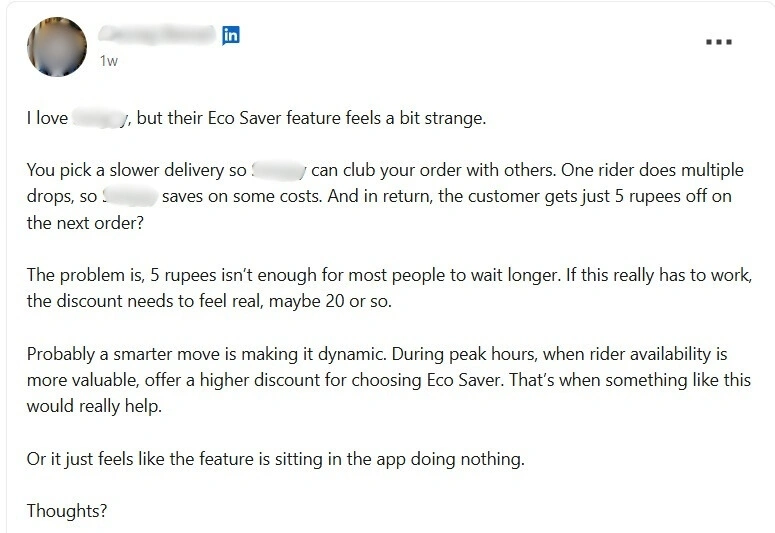
At first glance, this looked like a simple UI addition…but the spontaneous reactions in the form of comments from users online revealed something much deeper: how real consumers perceive sustainability, incentives, value exchange, and a brand’s intent.
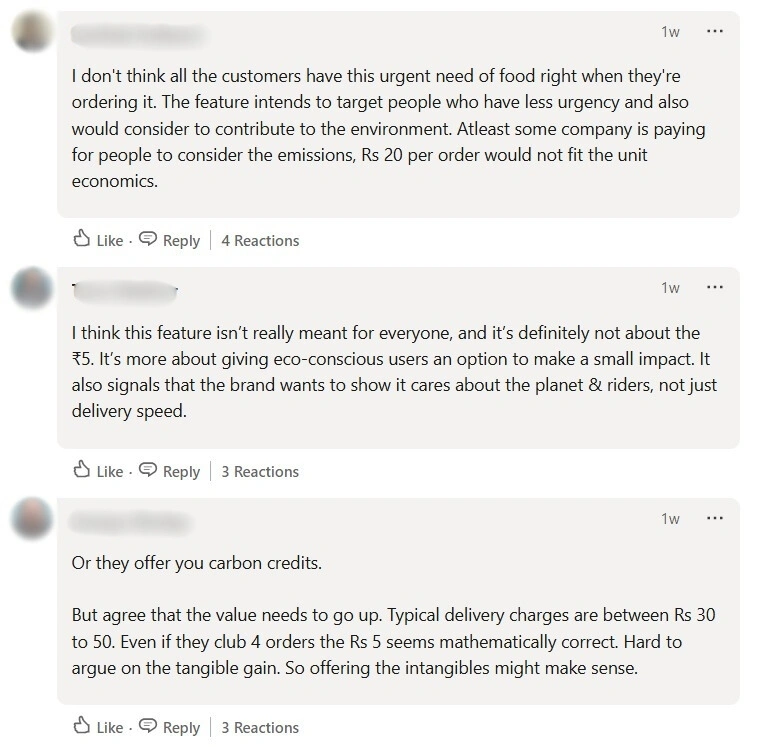
And since these responses weren’t collected through a survey or a behaviour research study but emerged organically, while this could make them more valuable than anything traditional research could have produced; it has to be taken into account that these comments and feedback are not necessarily from the key target audiences for that food delivery app, but from a cross-section of users with different agendas, requirements and perspectives.
We thought we would analyse these comments and put together the key consumer insights decoded from these real conversations, for your reference:
Insight 1: Users Want to Feel Responsible, Not Manipulated
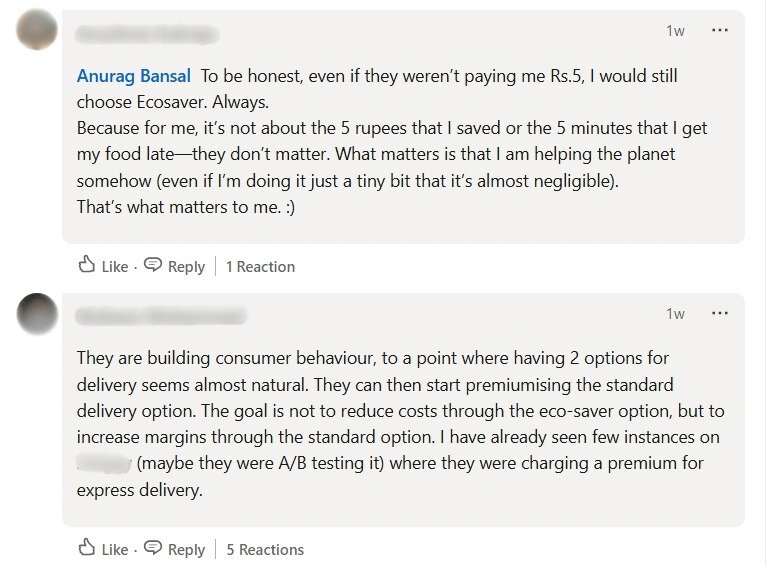
Some users said they would choose E Saver even without the ₹5 reward.
“Even if they weren’t paying me, I’d still choose Esaver… What matters is helping the planet.”
Implication:
A segment of users is willing to adopt sustainable behaviours for emotional satisfaction, not discounts. Monetary nudges are not the only motivators. Brands can build delight by enabling users to feel good rather than earn small rewards.
Insight 2: Hunger Beats Good Intentions
Many users highlighted a practical truth—food delivery is a time-sensitive category.
“When people are hungry, patience evaporates fast.”
“Longer delay = colder food.”
Implication:
Sustainability cannot be positioned against food experience. Any delay-based incentive works only when food quality is guaranteed. Some factors are hygiene in a category.
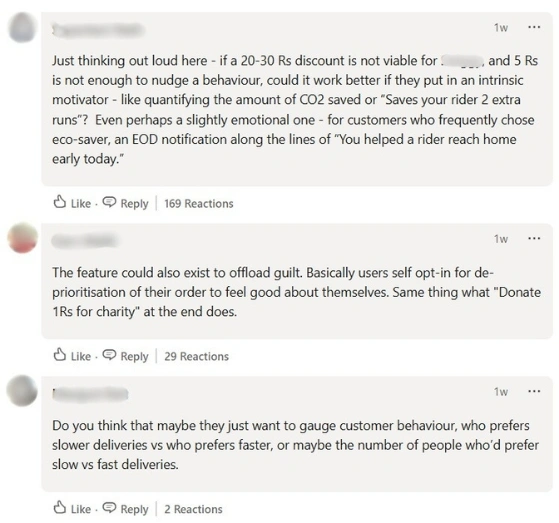
Insight 3: The E Saver Choice Doubles as a ‘Guilt-Offloading’ Button
Users compared this feature to rounding off payments for charity.
“It helps users offload guilt and feel good about themselves.”
Implication:
E Saver acts as a self-image enhancer, not just a cost reducer. The value is identity-based, not transactional. The service provider can lean into messaging around “You did a good thing today,” not “You saved ₹5.” as this may resonate better with a certain segment that values validation.
Insight 4: ₹5 Doesn’t Drive Behaviour Change
The strongest sentiment was that the incentive is too small to matter.
“₹5 isn’t enough to make people wait.”
“Even ₹20 won’t be enough.”
Implication:
Monetary rewards must be replaced with meaningful impact indicators—carbon credits, saved CO₂, rider benefit, or loyalty accumulation. Impact > Discount.
Insight 5: Users Are Smart Enough to Decode Business Intent
Many users believe the feature benefits the service provider more than them.
“The food delivery app optimises its costs; customers get ₹5.”
“It’s more operational relief than environmental change.”
Implication:
Consumers today analyse brand intent, not just UX. Transparency is key: if E Saver also reduces operational cost, say it. Honesty builds trust more than symbolic benefits.
Insight 6: Users See It as Behaviour Testing
Some suspect it’s an A/B experiment.
“They are assessing who prefers slower deliveries.”
“This can later be used to premiumise standard delivery.”
Implication:
Consumers know they’re part of experimentation. Product teams must design with clarity, because users now perceive themselves as collaborators—not subjects.
If Consumers Were Product Managers
It was also super interesting to see how various Users suggested powerful alternatives:
✔ Show CO₂ saved
✔ Offer cumulative rewards, not ₹5 crumbs
✔ Provide emotional end-of-day acknowledgements
✔ Let frequent customers experience smart auto-selection
✔ Give perks like free delivery coupons after milestones
Consumers are not resisting sustainability. They just want it to be meaningful.
Conclusion: Sustainability Features Need Stronger Storytelling, Not Bigger Discounts
The food delivery app’s E Saver option reveals that sustainable behaviour can be nudged—not by paying users, but by recognizing them.
Incentives should make users feel:
Responsible
Appreciated
Informed
Engaged
Not underpaid.
A ₹5 button opened a gateway into consumer psychology. And the insight is clear:
Users don’t want to be incentivised to care; they want their care to matter.
What Real Users Are Saying on LinkedIn