
In the boardroom, there is a harsh truth that creative directors often hate to hear: You cannot pay payroll with “likes.”
For the last decade, digital marketing has been obsessed with vanity metrics. We celebrate viral views, click-through rates (CTR), and impressions. But how many times have you seen a campaign go “viral,” racking up millions of views, only to result in flat sales?
This is the great disconnect of modern advertising. We have become experts at capturing attention, but we are failing at capturing intention.
The reason is simple: Attention is not the same as Connection.
A viewer can watch your ad because it is loud, weird, or funny, but if that entertainment does not trigger a specific emotional lever in the brain, the wallet stays closed. To fix this, we need to move beyond asking “Did they see it?” and start asking “Did they feel it?”
This is the promise of Emotion AI. By moving from vanity metrics to emotional metrics, brands can finally bridge the gap between ad spend and revenue. While this article focuses specifically on the financial ROI of the technology, those looking for a comprehensive overview of the tech stack itself should explore The Complete Guide to Emotion AI in Market Research: Decoding the Subconscious Consumer, which serves as the central resource for understanding the underlying science.
The Neuroscience of the Buy Button (System 1)
To understand why traditional analytics fail to predict sales, we must look at the human brain.
Nobel Prize-winning psychologist Daniel Kahneman famously divided human thought into two systems:
- System 1: Fast, instinctive, and emotional.
- System 2: Slow, deliberative, and logical.
Most marketers pitch to System 2. They list features, prices, and specs. But neuroscience tells us that 95% of purchasing decisions are made by System 1. We buy on emotion and justify with logic.
The Science of “Somatic Markers”
When a consumer watches a truly effective ad, their brain creates a Somatic Marker. This is essentially an emotional bookmark. If an ad makes you feel intense Joy or Warmth, your brain tags the brand logo with that feeling. Two weeks later, when you are standing in a grocery aisle scanning 50 different detergent brands, your System 1 brain recognizes the logo and unconsciously retrieves that “warm” feeling. Your hand reaches for the product before you have even read the price.
The Data: Feelings = Revenue
This isn’t just theory. Nielsen, one of the world’s largest data measurement firms, found that ads with above-average emotional scores generate a 23% lift in sales volume compared to average ads. Conversely, ads that focused purely on information (features/price) often saw negative sales lift.
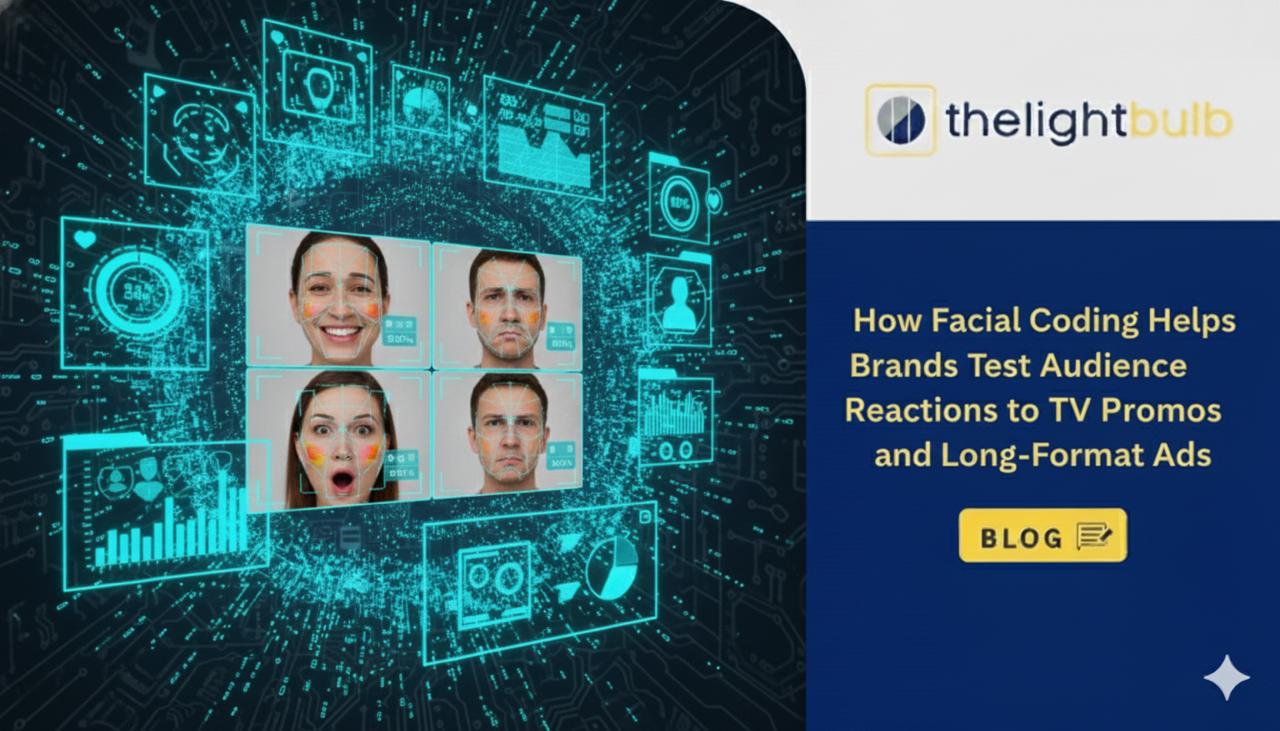
It is important to distinguish that while TV ratings measure reach (how many watched), Emotion AI measures resonance (how many cared). For a deeper look at how this distinction plays out in video testing methodology, specifically regarding how facial coding helps brands test audience reactions to TV promos and long-format ads, it is clear that resonance is the stronger predictor of success.
The Two Metrics That Print Money: Valence & Arousal
If you want to predict sales, you need to stop looking at “Views” and start looking at the Emotion Matrix. This matrix is built on two core biological signals:
- Valence: Is the feeling Positive (Joy) or Negative (Disgust/Fear)?
- Arousal: How intense is the physiological reaction? (A yawn vs. a racing heart).
When you plot your ads on this matrix, they fall into four quadrants. Only one of them drives massive revenue.
The “Sweet Spot” (High Arousal + Positive Valence)
This is the viral sales driver. The viewer is laughing, crying tears of joy, or feeling a rush of inspiration.
Result: High Memory Encoding + High Purchase Intent.
Example: Nike’s “Just Do It” campaigns often hit this zone, creating a cult-like brand loyalty that justifies premium pricing.
The “Nice but Forgettable” (Low Arousal + Positive Valence)
This is where most “safe” corporate advertising lands. The ad is pleasant. The actors are smiling. The music is generic upbeat ukulele.
Result: The viewer thinks “That’s nice,” and immediately forgets it.
Sales Impact: Zero. You wasted your media buy.
The Danger Zone (High Arousal + Negative Valence)
This creates strong memories, but bad ones. If an ad is “annoying” (loud noises) or “offensive,” it triggers high arousal but negative valence.
Result: The brain creates a Somatic Marker of “Avoidance.” You have effectively paid money to tell people not to buy your product.
Understanding these metrics is step one, but the ultimate goal is assigning a specific number to them. This leads to the question of whether emotion AI can predict buying intent and what is actually possible today, specifically regarding how AI uses these signals to calculate a concrete “Purchase Probability Score.”
Emotional Continuity: From Ad to Checkout
Here is a scenario that kills millions in revenue every year: The Cold Shower Effect.
Imagine you see an Instagram ad for a travel app. The ad is breathtaking—sunsets, romance, adventure. Your Emotion AI score for the ad is off the charts (High Joy, High Arousal). You click “Book Now.”
Suddenly, you are dropped onto a mobile website that is gray, text-heavy, and asks you to fill out 15 form fields before you can see prices.
Your emotion crashes. You go from “High Arousal” to “High Frustration” in three seconds. You leave.
The sale was won by the ad, but lost by the experience.
To boost sales, you must maintain Emotional Continuity. The feeling the ad created must be sustained by the landing page and the checkout flow. This is why it is critical to understand how emotion AI improves mobile app UX testing and design decisions, ensuring the hand-off from ad to app is seamless. Furthermore, brands must be proactive in using emotion AI to spot and smooth out digital experience pain points that cause this revenue-killing friction.
Strategic Application: Optimizing the Funnel
Different emotions trigger different buying behaviors. A smart marketer maps specific emotional targets to each stage of the sales funnel.
- Top of Funnel (Awareness): Target “Surprise”
- Emotion AI Goal: Maximize Surprise in the first 3 seconds.
- Why: Surprise creates a “Puncture” in the brain’s filter.
- Middle of Funnel (Consideration): Target “Trust” & “Calm”
- Emotion AI Goal: Maximize Positive Valence and minimize Anxiety.
- Why: High anxiety kills the ability to process information.
- Bottom of Funnel (Action): Target “Gratification”
- Emotion AI Goal: Joy signals upon confirmation.
Case Studies: The ROI of Empathy
Let’s look at real-world examples of how emotional optimization lifts the bottom line.
Example A: The Confusing Comedy (CPG Brand)
A snack brand created a funny 30-second spot. The focus group said they loved it. However, sales didn’t move. Emotion AI Analysis: The facial coding revealed that while people laughed at the joke (0:15), they showed “Brow Furrow” (Confusion) at 0:25, exactly when the new packaging was shown. The joke distracted them from the product. The Fix: They re-edited the ad to separate the joke from the product reveal. The Result: Confusion dropped, brand recall spiked, and the campaign resulted in a 15% lift in shelf sales.
Example B: Insurance – Fear vs. Relief
An insurance company ran ads focused on car accidents (High Fear). They got clicks, but low conversion. Emotion AI Analysis: The “Fear” persisted even after the user landed on the quote page. Users were too stressed to fill out complex forms. The Fix: They pivoted the creative to focus on the resolution of the accident (The Relief). The Result: By entering the funnel in a state of “Relief” rather than “Fear,” users were more cognitively available to complete the quote, increasing requests by 12%.
Retaining the Revenue: The Post-Purchase Emotion
In the subscription economy, the sale isn’t the finish line. It’s the starting line. Lifetime Value (LTV) is the true metric of success.
If a user buys your software or gadget but feels frustrated while setting it up, they will churn. You acquired a customer (Sales Win) but lost the profit (Retention Fail).
Emotion AI helps you protect your sales revenue by ensuring the “Unboxing” or “Onboarding” experience maintains the high generated by the ad. The sale isn’t truly finished until the user successfully uses the product, which is why identifying how emotion AI identifies customer struggle during product onboarding or setup is essential for protecting LTV.
Putting it All Together: The Emotional P&L
For too long, “Brand” and “Performance” have been siloed. Brand teams worried about feelings; Performance teams worried about clicks.
Emotion AI unifies them. It proves that Feeling is Performance.
Brands that treat emotion as a financial metric optimizing for it just as rigorously as they optimize for CPC or CPM are the ones seeing double-digit growth. They are not just buying impressions; they are buying mental availability.
Ready to build a strategy that links every emotional touchpoint from the TV ad to the mobile checkout directly to revenue? The next logical step is building a data-driven customer journey map with emotion AI insights to visualize and optimize that entire flow.
Conclusion
Is Emotion AI a “nice to have”? In a market where competitors are fighting for every scrap of attention, understanding the subconscious drivers of your customers is no longer a luxury. It is a survival mechanism.
Emotion is the strongest currency in the modern economy. It dictates what we remember, what we share, and ultimately, what we buy. If you aren’t measuring it, you are managing your marketing budget in the dark.
Call to Action: Call to Action: Audit your highest-spending ads this quarter. You know how many people saw them. But do you know how many people felt them? It might be the missing link in your sales strategy.
Frequently Asked Questions (FAQs)
What is the difference between “Viral” and “Sales-Driving” emotion?
Viral content typically triggers high Arousal (shock, laughter) but doesn’t always link that feeling to a brand. Sales-driving content links that Arousal to a specific brand identity or solution (Positive Valence + Brand Linkage), creating a memory structure that triggers a purchase later.
Can Emotion AI predict the exact dollar amount an ad will generate?
No model is perfect. However, Emotion AI provides a probabilistic lift. It can predict that Ad A has a 70% higher chance of driving sales than Ad B based on its ability to generate engagement and memory encoding. This allows marketers to allocate budget to the “winner” before spending millions.
Does high emotional engagement always lead to sales?
Not always. If the emotion is negative (Disgust) or if the emotion is disconnected from the product (the “Vampire Effect,” where the creative overpowers the brand), high engagement won’t convert. The key is Emotional Alignment; the feeling must be relevant to the purchase motivation.
How does this impact Customer Acquisition Cost (CAC)?
Better emotional targeting lowers CAC. When an ad resonates emotionally, click-through rates (CTR) increase and Relevance Scores (on platforms like Meta/Google) go up, which lowers your cost-per-click. Furthermore, higher emotional resonance improves conversion rates, meaning you need less traffic to get a sale.
How does Emotion AI increase sales for brands?
Emotion AI identifies which parts of an ad create positive, high-arousal emotional responses—the signals most strongly linked to memory and buying behavior.
By optimizing creatives and landing pages around these emotional peaks, brands lift conversion rates, reduce CAC, and drive measurable revenue.
Can AI predict customer behavior?
AI cannot forecast exact dollar outcomes, but it can predict probabilities such as which ad version is more likely to drive purchases based on emotional engagement patterns.
These predictions allow marketers to invest in the highest-performing creative before spending millions on media.
What is the Vampire Effect in advertising?
The Vampire Effect occurs when an ad is entertaining but steals attention away from the brand or product.
Viewers remember the joke, mascot, or storyline but forget who sponsored it resulting in poor sales despite high engagement.
How to create a customer journey map using AI?
AI aggregates behavioral, emotional, and contextual data across touchpoints ads, landing pages, apps, checkout, and support to identify where customers feel delight or friction.
This data forms a visual, step-by-step journey map that highlights drop-off points and recommends targeted improvements.
What is the difference between felt emotions and displayed emotions?
Felt emotions are the internal, subconscious reactions a person experiences.
Displayed emotions are the visible micro-expressions or behaviors captured through facial coding or body language that reveal those internal states.