How Facial Coding Helps Brands Test Audience Reactions to TV Promos and Long-Format Ads
How Facial Coding Helps Brands Test Audience Reactions to TV Promos and Long-Format Ads
In the world of advertising, the stakes have never been higher. A 30-second spot during the Super Bowl costs roughly $7 million just for the airtime, excluding the millions spent on production, talent, and special effects. Even a standard prime-time TV campaign or a global movie trailer launch involves a massive capital expenditure.
With this much money on the line, relying on “gut feeling” is financial negligence.
Traditionally, brands have relied on focus groups and surveys to test creatives. They gather a room of people, show them the ad, and ask, “Did you like it?” The problem is that human beings are notoriously bad at reporting their own feelings.
This is known as the “Politeness Bias” (or Social Desirability Bias). In a focus group, participants often nod along, laugh when others laugh, and say they “loved” the ad to please the moderator or avoid looking unintelligent. Meanwhile, their subconscious reaction might have been boredom or confusion.
Enter Facial Coding.
Facial coding is the technology that strips away the bias. By analyzing the involuntary micro-expressions that flash across a viewer’s face in milliseconds, brands can see exactly how an audience felt, second by second. While this deep dive explores the specific application of media testing, the broader technology is foundational to modern analysis. For a comprehensive view of the underlying science, The Complete Guide to Emotion AI in Market Research: Decoding the Subconscious Consumer serves as a central resource.
How Facial Coding Works for Video Content
Facial coding for video does not require strapping people into a lab chair. Modern “Pre-testing” is done remotely, at scale, using standard webcams.
The Methodology: From Webcam to Data
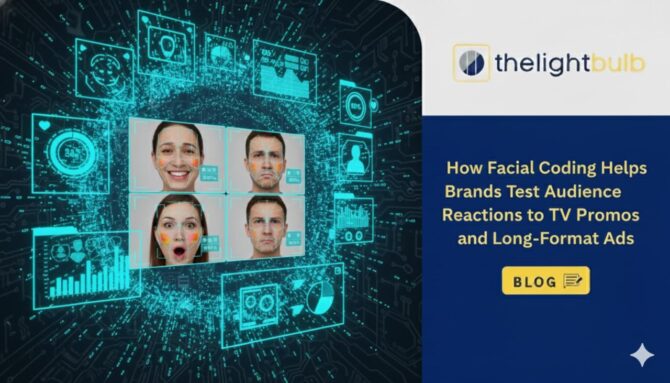
Participants (who have explicitly opted-in) watch the video content on their laptop or desktop. As the video plays, the Emotion AI algorithm tracks key landmarks on their face—the corners of the mouth, the furrow of the brow, the widening of the eyes.
These movements are translated into Action Units (AUs), which are then categorized into core emotions: Joy, Surprise, Sadness, Fear, Anger, Disgust, and Contempt.
The “Trace”: Visualizing the Emotional Journey
The output is not a single score; it is a time-series graph called the Emotional Trace.
Y-Axis: Represents the intensity of the emotion (0 to 100).
X-Axis: Represents the timeline of the video (0:00 to 0:30).
This allows editors to see that at 0:12, the joke landed (High Joy), but at 0:22, the product reveal caused a drop in engagement (Neutral/Boredom).
Active vs. Passive Viewing
It is crucial to distinguish between the “Lean-Back” experience of TV and the “Lean-Forward” experience of apps. When watching a movie trailer, we expect the user to be relatively still, absorbing the story. We look for Emotional Peaks. In contrast, when a user is navigating a mobile app, we look for Cognitive Ease. This distinction is critical when considering how emotion AI improves mobile app UX testing and design decisions, as the signals for passive entertainment differ significantly from active user frustration.
The Anatomy of a Perfect Trailer/Promo
Whether it is a 2-minute movie trailer or a 30-second detergent commercial, the structural requirements for emotional engagement are similar. Emotion AI allows us to dissect the video into three critical phases.
1. The Hook (0-5 Seconds)
In the age of TikTok and the “Skip Ad” button, you do not have 30 seconds. You have 5. Facial coding data focuses heavily on the “Surprise” and “Attention” metrics in these opening seconds. If the trace line is flat during the first 5 seconds, your ad is effectively invisible. First impressions are universal; just as a trailer must hook a viewer instantly, a software product must hook a user immediately to prevent churn. Similar principles apply when analyzing how emotion AI identifies customer struggle during product onboarding or setup.
2. The Narrative Arc
Great storytelling usually follows a “U” shape or a rising staircase.
The Setup: Establishing context (Neutral/Low Attention).
The Conflict: Creating Tension (Fear, Sadness, or High Attention).
The Resolution: The payoff (High Joy/Surprise). If your ad is flat-lining in the middle, you have entered the “Boredom Valley.” This is where viewers pick up their phones.
In digital experiences, we call these drop-off points “friction,” whereas in video, they are “tune-out” points. Both scenarios benefit from using emotion AI to spot and smooth out digital experience pain points, ensuring the user remains engaged throughout the journey.
3. The Branding Moment
Often, an ad is funny and engaging, but the sales fail. Why? Because when the logo appeared, the audience was looking at the dog, not the brand. Emotion AI combined with Eye Tracking ensures that the “Peak Joy” moment aligns with the branding visual.
Does “Liking” the Ad Mean “Buying” the Product?
This is the million-dollar question. A Super Bowl ad might make everyone laugh, but does it move the product?
The Metrics: Valence vs. Arousal
To predict sales impact, we analyze two dimensions:
Valence (Positivity): Is the emotion positive or negative? (Joy vs. Disgust).
Arousal (Intensity): How strong is the feeling? (A polite smile vs. a burst of laughter).
High Arousal + Positive Valence = Memory Encoding. Neuroscience tells us that we remember things that make us feel intensely. If an ad generates high arousal, it creates a “Somatic Marker” in the brain, linking that emotion to the brand.
The Sales Correlation
Data consistently shows that ads with high emotional engagement scores (top quartile) drive significantly higher short-term sales lift and long-term brand equity compared to ads with low scores. To understand the numbers behind this impact, it is worth exploring how emotion AI boosts sales and whether people truly feel your ads.
But can we go further? Can a smile predict a ticket purchase or a subscription sign-up? The industry is now examining whether emotion AI can predict buying intent and what is actually possible today.
Optimizing the Edit: Data-Driven Storytelling
The true power of Emotion AI lies not just in “Pass/Fail” testing, but in Creative Optimization. This is where the data enters the editing suite.
Editors can use the “Emotional Trace” to make surgical cuts:
- The Failed Joke: “We thought the line at 0:15 was funny, but the Joy line is flat. Cut it to save 3 seconds.”
- The Confusing Scene: “The pivot at 1:30 caused a spike in ‘Brow Furrow’ (Confusion) instead of ‘Fear’. We need to re-score the music or add a sound effect to clarify the mood.”
- The Pacing: “The middle section has 10 seconds of low arousal. Let’s tighten the edit to keep the energy up.”
Long-Format Application: TV Pilots
Studios now test entire pilot episodes. By aggregating the emotional data of 500 viewers, they can see exactly which character introduction caused excitement and which subplot caused people to tune out. This data influences script rewrites and casting decisions for the rest of the season.
Where Media Fits in the Customer Journey
A TV promo is rarely the final step; it is usually the first touchpoint in a long customer journey.
The Awareness Stage
The job of the promo is to generate Awareness and Interest. But what happens next? If your TV ad promises “Exhilaration” (High Arousal), but your website is slow, boring, and confusing (Low Valence), you create an Emotional Disconnect.
The customer feels let down, and they leave.
To build a successful brand, the emotional promise made in the ad must be fulfilled by the UX of the website and the ease of the checkout process. This alignment highlights why e-commerce needs data-driven customer journey maps, ensuring that expectations match reality. Furthermore, brands can optimize the entire funnel by building a data-driven customer journey map with emotion AI insights that tracks the flow of emotion from the TV ad all the way to the checkout.
Case Studies: When Facial Coding Saved the Campaign
Example 1: The Horror Movie That Wasn’t Scary
A major studio was releasing a supernatural horror film. The initial trailer tested well in surveys (“It looks cool”), but Facial Coding revealed a problem: The “Fear” metric was shockingly low. The Fix: The editors realized the sound design was drowning out the tension. They re-mixed the trailer, adding silence before the jump scares. The Result: The re-tested trailer showed a 40% spike in Fear/Surprise, and the movie opened #1 at the box office.
Example 2: The Polarizing Super Bowl Spot
A snack brand created an edgy comedy spot. The Data: The general population showed “Joy.” However, the data revealed high “Disgust” signals specifically among women aged 35-50—their primary grocery shoppers. The Decision: Realizing they were alienating their core buyer, they swapped the ending for a softer alternative before the big game, saving the brand from a potential PR backlash.
Conclusion: Editing with Empathy
For decades, creative directors have argued with data analysts. Creatives say, “You can’t measure art.” Analysts say, “Art doesn’t always sell.”
Emotion AI ends this argument. It bridges the gap. It allows us to move from “I think this is funny” to “I know this is funny.”
By testing TV promos and long-format ads with facial coding, brands ensure that their budget is spent on content that actually resonates. They stop paying for boredom and start investing in connection.
Call to Action: Don’t let your $5M media buy fail because of a bad edit. Before you lock the picture, unlock the subconscious. Test, iterate, and optimize based on real human emotion.
Frequently Asked Questions (FAQs)
How accurate is facial coding for ad testing?
Facial coding is highly accurate when used on high-quality panels. While it doesn’t read “minds,” it reads “muscle movements” with over 90% accuracy compared to human coders. The key is using an aggregated sample (e.g., N=300) to smooth out individual anomalies.
Do participants know they are being recorded?
Yes. Ethical facial coding is always permission-based. Participants are recruited for the study, they grant explicit access to their webcam for the duration of the video, and they are usually compensated. The video data is processed to extract emotional data points and then typically discarded or anonymized to protect privacy.
Can facial coding work on mobile phones?
Yes. As seen in the context of how emotion AI improves mobile app UX, modern algorithms are optimized for mobile cameras. This is increasingly important as more video consumption shifts to TikTok, Instagram Reels, and YouTube Shorts.
What is the “Attention Score” in facial coding reports?
You may see an Attention Score in your data. This metric indicates how engaged and involved a respondent was throughout the exposure to the stimulus (such as an ad or video). A higher Attention Score reflects sustained focus and active viewing, helping identify moments where the creative successfully holds audience interest across the duration of the content.
Does this replace traditional surveys?
No, it complements them. Facial coding tells you what they felt. Surveys tell you what they thought (or what they remember). Combining both gives you the “System 1” (Subconscious) and “System 2” (Conscious) view of your creative performance.
How to identify emotions from facial expressions?
Emotion AI tracks micro-movements in facial muscles called Action Units to infer emotional states like joy, surprise, or frustration.
Because these reactions are involuntary, they reveal how people actually feel in real time.
What is the most important part of an ad?
The first 3–5 seconds known as the Hook are the most critical for grabbing attention before viewers tune out or skip.
If emotional engagement is flat at the start, the rest of the ad rarely recovers.
How is facial recognition used in marketing?
In marketing, it’s not about identifying who someone is, but how they react.
Facial coding analyzes expressions to measure emotional response to ads, trailers, packaging, and digital experiences.
What are the three types of facial coding?
Manual Coding: Human experts label Action Units frame-by-frame.
Automated Facial Coding: AI models detect expressions in real time.
Hybrid Systems: Human review plus automation for higher accuracy.
What is one benefit of using the facial action coding scheme (FACS) to code facial expressions?
FACS provides an objective, standardized way to measure specific muscle movements rather than subjective interpretations.
This precision makes emotional analysis consistent, comparable, and scientifically grounded.