Can Emotion AI Predict Buying Intent? The Science Behind Purchase Probability Scores
Every marketer, from the CMO of a Fortune 500 company to the owner of a Shopify store, wants the same thing: A Crystal Ball.
We spend billions of dollars annually on third-party cookies, tracking pixels, and predictive algorithms, all to answer one simple question: What will this person do next?
For decades, we have relied on behavioral proxies. We assume that if someone visits a pricing page three times, they want to buy. But behavioral data is flawed. It tells us what happened, but it doesn’t tell us why. A user might visit your pricing page three times not because they are ready to buy, but because they are confused by your tiered subscription model.
The industry is now asking a more provocative question: Can Artificial Intelligence look at a human face and predict a purchase?
Can a camera detect the subtle biological signals of desire, calculation, and commitment before the user even clicks a button?
The answer is complex. We are not living in the sci-fi world of Minority Report just yet. AI cannot read minds with 100% certainty. However, it can read biological truth with high statistical probability.
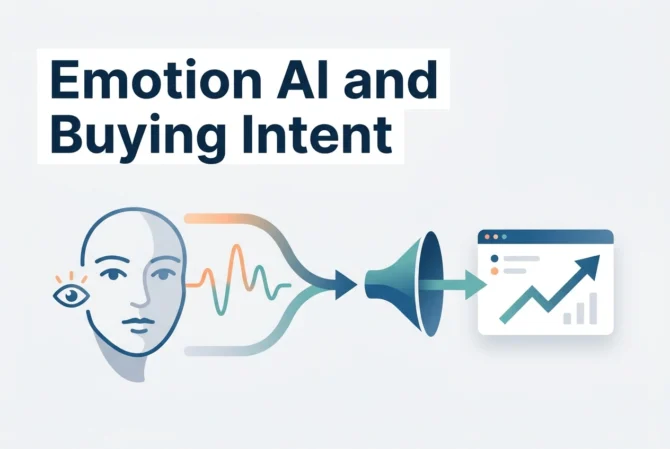
In this deep dive, we will separate the hype from the reality. We will explore how “Fusion Models” are combining facial coding, eye tracking, and mouse movement to calculate a Purchase Probability Score in real-time.
This article explores the advanced predictive capabilities of biometric technology. For a foundational understanding of the core mechanics and ethical considerations of this technology, read our central resource: The Complete Guide to Emotion AI in Market Research: Decoding the Subconscious Consumer.
Differentiating “Sentiment” from “Intent”
To predict the future, we must first distinguish between two concepts that marketers often confuse: Sentiment and Intent.
- Sentiment (Valence): This answers the question, “Do I like this?” It is an emotional reaction.
- Intent (Commitment): This answers the question, “Will I exchange resources (money/time) for this?” It is a behavioral calculation.
The Gap: The “Ferrari Effect”
You can stand in front of a Ferrari dealership and feel intense Joy and Admiration (High Positive Sentiment). However, if you have $50 in your bank account, your Buying Intent is zero.
Conversely, you can buy a roll of trash bags with zero emotional joy (Neutral Sentiment) but 100% Buying Intent because you need them.
Emotion AI has historically been great at measuring Sentiment. The breakthrough in 2024 is bridging the gap to Intent. Advanced algorithms now look for the specific combination of Arousal (Intensity) and Focus (Cognitive Processing) that signals a decision is being made, not just a feeling being felt.
The ROI of Feeling: While sentiment isn’t the only factor, high emotional engagement is a massive correlated driver that often precedes intent. To deeply explore the financial correlation and revenue impact, explore our related article on [Do People Feel Your Ads? How Emotion AI Boosts Sales]
The Predictive Formula: Fusion Modeling
How do we mathematically predict a purchase? We use a technique called Fusion Modeling (or Multi-Modal Emotion AI).
A single data point (e.g., a smile) is weak. But when you layer three distinct biometric signals on top of each other, the predictive accuracy skyrockets to over 85%.
Signal 1: Valence (The Face)
Question: “Is the reaction positive?” The AI tracks the zygomatic major muscles (Action Unit 12 – Smiling) versus the corrugator supercilii (Action Unit 4 – Frowning).
Predictive Clue: A user who frowns at the price tag usually has low intent, unless they immediately scroll to the “Features” list (calculating value).
Signal 2: Attention (Eye Tracking)
Question: “What is the focus?”
Knowing that they are smiling is useless if you don’t know what they are smiling at.
Predictive Clue:
- High Intent: Fixation on the “Value Proposition” text + Price.
- Low Intent: Fixation on the stock photography or decorative elements.
Signal 3: Behavior (Mouse/Scroll Velocity)
Question: “Is the movement purposeful?”
Predictive Clue: “Goal-Directed Movement.” High-intent users typically move the mouse in straighter lines toward CTAs. Low-intent browsers tend to have “meandering” mouse paths and erratic scroll speeds.
The Formula
(Positive Valence) + (Value-Based Fixation) + (Goal-Directed Velocity) = High Purchase Probability.
Identifying the “Fence-Sitters” (The High-Value Target)
The most valuable prediction AI can make isn’t identifying the people who will definitely buy (the “Yes” group) or the people who definitely won’t (the “No” group).
The money is in predicting the “Maybe” group. These are the Fence-Sitters.
Traditional analytics cannot spot them. They look like “Bounces.” But Emotion AI identifies them through a unique biological signature: Conflict.
The Signal: High Engagement + High Cognitive Load
A Fence-Sitter often shows:
- High Attention (They are staring at the product).
- Action Unit 4 (Brow Furrow) (They are confused or thinking hard).
- Action Unit 24 (Lip Press) (They are suppressing frustration).
The Translation: “I want this product (Engagement), but I don’t understand the shipping policy (Cognitive Load).”
If you can identify this state in real-time, you can trigger an intervention. Instead of a generic “10% Off” popup, a chatbot can appear saying: “Unsure about shipping? We offer free returns.”
Diagnosis: If you can spot the confusion blocking the intent, you can fix it. You can learn how to diagnose and address these specific friction points in detail in our dedicated article: [Using Emotion AI to Spot and Smooth Out Digital Experience Pain Points]
Contextual Intent: Passive vs. Active
Predicting intent requires understanding the environment. The biological signals for “I want to watch this movie” are different from “I want to buy these shoes.”
Passive Intent (Media & Entertainment)
When testing a movie trailer or TV ad, “Intent” means “Intent to Watch.” Here, the predictive model favors Surprise and Sustained Attention. If the viewer looks away (distraction) for more than 2 seconds, intent drops near zero. The goal is “Immersion.”
Media Application: See how we measure the emotional spark that starts the journey and test audience reactions to long-format ads in [How Facial Coding Helps Brands Test Audience Reactions to TV Promos and Long-Format Ads]
Active Intent (E-Commerce)
When shopping, “Intent” means “Intent to Transact.” Here, surprise is actually bad (you don’t want to be surprised by the price). The predictive model favors Calmness and Focus. The “Flow State” is the best predictor of conversion.
Shopping Application: Active browsing requires a different map than passive media consumption. To understand how to structure this journey, review [Why E-Commerce Needs Data-Driven Customer Journey Maps]
Mobile Intent: The Micro-Signals
Predicting intent on a mobile device is harder because the sessions are shorter and more fragmented.
On a desktop, a user might compare products for 10 minutes. On mobile, they decide in 10 seconds. The AI must look for Micro-Signals:
- The “Thumb-Stop”: Did the scroll speed drop to zero instantly?
- The “Zoom”: Did they pinch-to-zoom on the product image? (High intent signal).
- The “Closer Look”: Mobile facial coding can detect if the user physically moved the phone closer to their face. This physical “leaning in” is a primal signal of interest.Mobile Nuance: Mobile users show intent differently due to shorter sessions. Unpack the nuances of mobile behavior and how to improve design decisions in [How Emotion AI Improves Mobile App UX Testing and Design Decisions]
Predicting “Lifetime Value” (Intent to Stay)
Most predictive models stop at the sale. This is short-sighted. The true power of Emotion AI is predicting Lifetime Value (LTV) — the intent to stay and buy again.
The greatest predictor of churn isn’t the price; it’s the Emotional Residue of the first experience.
The Onboarding Prediction
If a user buys your software but their facial coding during the setup process shows High Frustration and Disgust, the AI predicts a Low LTV.
Even though they paid, they are emotionally exhausted. They will likely cancel next month.
Conversely, if the setup process elicits Joy (the “Aha!” moment), the AI predicts High LTV and high referral potential.
Retention Logic: The best predictor of churn is a frustrating setup. Learn to secure long-term intent and fix the critical setup phase in [How Emotion AI Identifies Customer Struggle During Product Onboarding or Setup]
From Theory to Practice: Aggregating the Data
So, how do you actually use this? You don’t need to be a data scientist to benefit from predictive Emotion AI.
Modern platforms integrate these “Probability Scores” into standard dashboards.
- Input: You run a study with 100 participants browsing your site or viewing your concept.
- Processing: The AI analyzes the fusion of Face + Eye + Mouse data.
- Output: You receive a Heatmap of Intent.
You might see that your “Premium Bundle” generates higher Sentiment but lower Intent than your “Basic Bundle” because the price point triggers a micro-expression of Fear. This data allows you to adjust pricing or messaging before you launch.
Building the Model: Ready to map the data? We explain how to strategically plot and aggregate these intent data points in our technical guide, [Building a Data-Driven Customer Journey Map with Emotion AI Insights]
Conclusion: The Future is Probabilistic
We are entering a new era of marketing. The era of “Guessing” is ending; the era of “Probabilistic Empathy” is beginning.
Emotion AI does not read minds. It cannot guarantee that John Smith will buy a toaster on Tuesday.
But it can tell you, with remarkable accuracy, that John Smith is currently in a state of High Desire but High Confusion, giving you the unprecedented opportunity to step in and help him decide.
By moving from simple sentiment analysis to complex intent modeling, brands can stop marketing to demographics and start marketing to states of mind.
Call to Action: The technology exists today. The brands that start building their emotional datasets now will be the ones capable of predicting and influencing tomorrow’s sales.
Frequently Asked Questions (FAQs)
How accurate is Emotion AI at predicting sales?
Current fusion models (combining face, eye, and behavior) can predict purchase intent with 80-85% accuracy in controlled testing environments. This is significantly higher than survey-based intent (“I would buy this”), which often has a correlation of less than 40% with actual behavior due to social desirability bias.
Can Emotion AI predict intent in real-time for live users?
Currently, this technology is primarily used in Market Research and Testing environments (with opted-in panels), not on live e-commerce sites for random visitors. Privacy laws (GDPR/CCPA) prevent the unauthorized scanning of webcams. The goal is to optimize the design based on test panels, which then predicts behavior for the live audience.
Does a “Neutral” face mean “No Intent”?
Not necessarily. In high-focus tasks (like B2B procurement or banking), a neutral face often indicates Flow and Concentration, which are high-intent states. “Joy” is not always the goal; sometimes “Focus” is the goal. Context is key.
What is the “Fusion Model”?
A Fusion Model is an AI architecture that combines multiple data streams. Instead of just looking at the face (Visual), it looks at the face + where the eyes are looking (Attention) + how the mouse is moving (Behavior). By cross-referencing these signals, the AI reduces false positives and increases predictive confidence.
Is this technology expensive to run?
It has become democratized. While it used to require expensive lab equipment, modern platforms (like Realeyes, Affectiva, and others) run via standard webcams and cloud processing, making it accessible for mid-market brands to run predictive intent studies on new product launches.
What is an example of AI-driven emotion recognition?
AI-driven emotion recognition can detect specific facial muscle movements—such as a brow furrow (Action Unit 4) indicating confusion, or a lip press (Action Unit 24) indicating frustration—while a user interacts with a website or product. For example, if a user frowns at a pricing table, the AI flags this as a negative emotional reaction tied to that specific element.
What is an example of emotional fusion?
Emotional fusion occurs when multiple biometric signals are combined to generate a stronger predictive insight.
- Positive facial valence (smile)
- Eye fixation on the price/feature section
- Straight, goal-directed mouse movement toward the CTA
= High Purchase Intent
No single signal is strong alone, but fused together they create an accurate prediction.
Can Emotion AI predict not just purchases, but Lifetime Value (LTV)?
Yes—Emotion AI can estimate long-term value by analyzing emotional responses during onboarding and early use.
A user who shows sustained frustration or disgust during setup is statistically more likely to churn, while users who experience early “Aha!” moments (joy or relief) tend to stay longer and buy more.
Emotion in the first five minutes is often the strongest predictor of retention.
What are the limitations of AI in understanding human emotions?
AI can detect emotional signals—micro-expressions, attention shifts, arousal—but it cannot fully understand internal context, motivations, sarcasm, cultural nuance, or suppressed feelings without external cues.