How Emotion AI Identifies Customer Struggle During Product Onboarding or Setup
How Emotion AI Identifies Customer Struggle During Product Onboarding or Setup
Marketing sells the dream. Your ads promise a life of ease, efficiency, and joy. But onboarding delivers the reality: work.
This is the Unboxing Paradox. The moment a customer buys your software or opens your smart device, their excitement is at its peak. But the moment they start the setup process, that excitement collides with a wall of cognitive effort. They have to verify emails, configure settings, pair Bluetooth, or learn a new dashboard.
This creates a dangerous “Time-to-Value” gap.
If the user feels stupid, frustrated, or overwhelmed during these first 10 minutes, the dream dies. They might finish the setup, but the emotional damage is done.
Traditional analytics are useless here. They can tell you that 40% of users dropped off at “Step 3: Profile Setup.” But they cannot tell you why. Did they drop off because they were bored? Scared of making a mistake? Or angry at a confusing interface?
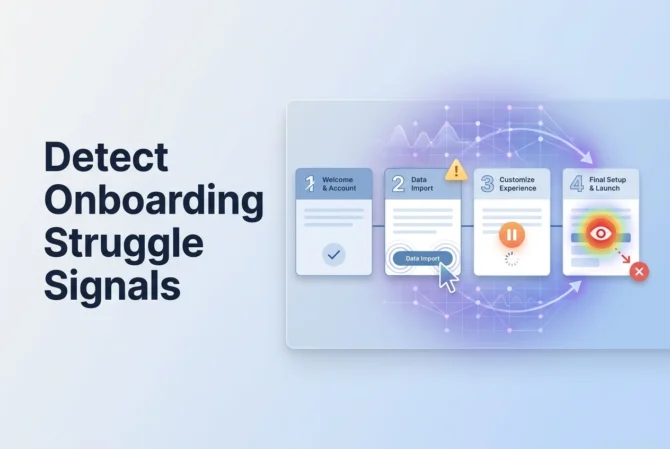
To fix churn, we must stop looking at completion rates and start looking at Struggle Metrics. By using Emotion AI, product teams can now identify the specific moments of friction that kill retention before the user even logs in a second time.
This article focuses on the retention application of biometric technology, but for a comprehensive overview of the core technology and wider uses, be sure to read The Complete Guide to Emotion AI in Market Research: Decoding the Subconscious Consumer.
Defining “Struggle” in Biometric Terms
In the world of UX, not all thinking is bad. A user should be thinking when they are learning a powerful new tool. The challenge for researchers is distinguishing between Healthy Learning and Unhealthy Struggle.
Emotion AI solves this by analyzing the nuances of facial muscle movements (Action Units).
The Face of Learning (Positive Friction)
When a user is engaged in a difficult but rewarding task (like learning a game mechanic), we see:
- Brow Furrow (Action Unit 4): Indicates concentration.
- Neutral or Loose Mouth: Indicates lack of tension.
- Sustained Gaze: They are reading or processing.
Verdict: Let them be. They are in the “Flow.”
The Face of Struggle (Negative Friction)
When a user hits a wall, the biological signal shifts:
- Brow Furrow (Action Unit 4): Still present (Cognitive Load).
- Lip Press (Action Unit 24) or Jaw Clench: This is the key differentiator. It signals Suppressed Anger or physical effort.
- Erratic Mouse Movement: The cursor moves rapidly in circles or darts between buttons. This is the digital equivalent of pacing the room.
Verdict: Intervention needed. They are not learning; they are suffering.
Struggle is just an intense form of friction. To understand the full spectrum of digital pain, including how to spot and smooth out the early warning signs, you can refer to our detailed analysis in Using Emotion AI to Spot and Smooth Out Digital Experience Pain Points.
The High Stakes of the “First Run” (FTUE)
Why obsess over the first 10 minutes? Because in the subscription economy, there is no second chance.
Industry benchmarks suggest that 40-60% of users who sign up for a free trial never log in a second time. They didn’t leave because the product lacked features. They left because the emotional cost of extracting value was too high.
Predicting Lifetime Value (LTV)
Emotion AI reveals a direct correlation between the Emotional Valence (positivity) of the first session and the user’s Lifetime Value.
- High Joy/Relief during Setup: High probability of renewal.
- High Frustration/Fatigue during Setup: High probability of churn, even if they successfully completed the setup.
A bad setup experience kills future intent. We explore the predictive power of emotion, showing exactly Can Emotion AI Predict Buying Intent? What’s Actually Possible Today in a separate piece.
Scenario A: The SaaS “Empty State”
One of the most anxiety-inducing moments in software is the “Empty State” when a user lands on a dashboard with no data.
The Scenario: You sign up for a Project Management tool. You land on the main screen. It is a blank white space.
The Biometric Reaction:
- Eye Tracking: Darting rapidly across the screen (seeking an anchor).
- Emotion: Spike in Anxiety and Confusion.
The Internal Monologue: “I don’t know where to start. I’m going to break this.”
The Fix: Using Emotion AI, companies have tested “Wizard-style” onboarding (step-by-step hand-holding) versus “Exploratory” onboarding. Data consistently shows that for complex B2B tools, reducing open-ended choices lowers anxiety and increases the “Joy” score upon the first successful action (e.g., creating a task).
Onboarding is a critical chapter in the wider customer lifecycle. If you want to see where it fits into the macro strategic view, explore Why E-Commerce Needs Data-Driven Customer Journey Maps
Scenario B: The Hardware/IoT Setup (Physical + Digital)
Setup becomes exponentially harder when it involves hardware (Smart Speakers, Fitness Trackers, Routers).
The Scenario: A user tries to pair a smart lightbulb with their WiFi. The Biometric Reaction: The user looks at the bulb, then the phone, then the manual.
The Struggle: The Emotion AI camera (on the phone) detects a “Disgust” micro-expression when the pairing fails for the second time.
The Mobile Context
This is a unique challenge because the user’s attention is split. Mobile Emotion AI is crucial here to detect the frustration caused by the app interface versus the physical device. If the app says “Searching…” for 30 seconds, facial coding often detects “Boredom” followed by “Anger.”
Mobile setup flows are uniquely frustrating due to screen size and context switching. We detail how to optimize the mobile portion of this experience in our guide, \[How Emotion AI Improves Mobile App UX Testing and Design Decisions\]
Active vs. Passive Frustration during Setup
Not all struggle looks like rage. In fact, the most dangerous form of struggle is silence.
Active Frustration (The Fighter)
- Signals: Rage clicking, aggressive typing, “Lip Press.”
- Meaning: They are trying to make it work. They are motivated.
- Fix: Fix the bug or clarify the error message.
Passive Frustration (The Resignee)
- Signals: A deep exhale (shoulders drop), head tilting back, breaking eye contact with the screen.
- Meaning: This is the “Sigh of Resignation.” They have given up. They aren’t closing the tab yet, but they have mentally churned.
- Fix: You need to radically simplify the process. They are overwhelmed.
The “Aha!” Moment: Measuring Success
We often define onboarding success as “The user completed the tutorial.” This is a vanity metric. A user can complete a tutorial while hating every second of it.
True success is the “Aha!” Moment—the precise second the user realizes the value of the product.
With Emotion AI, we can pinpoint this moment biologically. It appears as a spike in Surprise followed by Joy (Action Units 1+2+12).
Example: The moment the smart lightbulb finally turns blue.
Example: The moment the AI generates the first report.
If your onboarding flow ends without this biological spike, you haven’t onboarded them. You’ve just trained them.
Ensuring this “Joy” moment is key to recurring revenue. For a deep dive into the financial implications, learn how \[Do People Feel Your Ads? How Emotion AI Boosts Sales\]
Practical Implementation: Mapping the Struggle
So, how do you fix a broken onboarding flow? You build a Struggle Map.
- Recruit: Get 30 participants to go through your setup process while their webcam is on.
- Record: Capture facial coding, eye tracking, and screen activity.
- Overlay: Create a timeline of the setup process.
- Identify Peaks: Mark the exact timestamp where “Frustration” spiked above 20%.
- Correlate: Watch the video at that timestamp. Did it happen when they were asked for a credit card? When they had to create a complex password?
By visualizing struggle, you stop arguing about “UX Best Practices” and start solving real human pain.
Ready to visualize this data and put this methodology into practice? Follow our technical guide on \[Building a Data-Driven Customer Journey Map with Emotion AI Insights\]
Conclusion: Empathy as a Retention Strategy
Customer Acquisition Cost (CAC) is skyrocketing. It is expensive to get a user to try your product. It is tragic to lose them because your instruction manual was confusing.
Onboarding is not just a technical step; it is an emotional bridge. It is the bridge between the promise of your marketing and the reality of your product.
By using Emotion AI to identify and eliminate customer struggle, you are doing more than fixing UX. You are demonstrating empathy. You are telling the user, “We respect your time, and we want you to succeed.” And in the long run, that is the only retention strategy that works.
Call to Action: Audit your First Time User Experience today. Don’t just look at the funnel drop-off rates. Look at the faces of the people trying to use your product. Are they smiling, or are they struggling?
Frequently Asked Questions (FAQs)
What is the difference between “Friction” and “Struggle”?
Friction is a minor resistance (e.g., an extra click). Struggle is a compounded emotional state where the user feels unable to proceed or overwhelmed. Friction causes annoyance; Struggle causes churn. Emotion AI detects the intensity difference between the two.
Can Emotion AI detect struggle on mobile devices?
Yes. Modern facial coding works via the front-facing camera of smartphones. This is critical for testing “Out-of-Box” experiences where users are setting up hardware using a mobile app, as it captures the frustration of switching contexts.
How many users do I need to test to find struggle points?
You don’t need thousands. Research by Nielsen Norman Group suggests that testing with 5 to 8 users reveals 80% of usability issues. With Emotion AI, a sample size of 30 provides statistically significant emotional data to identify the major struggle zones.
Does the “Aha!” moment always look like Joy?
Not always. In professional B2B tools, the “Aha!” moments might look like Relief (shoulders dropping, exhale) or intense Focus (leaning in). It depends on the problem you are solving. If you are solving a painful tax problem, the goal is Relief, not Joy.
Is this data compliant with privacy laws?
Yes. When conducting these studies, users are recruited into a panel and give explicit consent for webcam recording. The data is used solely for product improvement, and reputable platforms anonymize the biometric data to protect user privacy.
Which technology is commonly used for emotional recognition?
The most commonly used technology is Facial Action Coding System (FACS)-based Emotion AI, which analyzes micro-expressions—tiny, involuntary facial muscle movements—to infer emotional states such as confusion, frustration, or joy. Modern systems often combine this with eye tracking and behavioral signals for higher accuracy.
What is the real-time application of Emotion AI?
In real time, Emotion AI can identify moments of user struggle during onboarding, setup, or digital interactions. For example, it can detect rising frustration (lip press, jaw clench) during a complex step and trigger an immediate intervention—like providing guidance, simplifying instructions, or offering help at the exact moment the user gets stuck.
Can Emotion AI predict churn during setup?
Yes. One of its strongest capabilities is predicting early-stage churn by analyzing emotional responses during the first session. High frustration, confusion, or resignation during the setup process is a strong predictor of low Lifetime Value (LTV), even if the user completes onboarding. Conversely, “Aha!” moments marked by joy or relief signal higher retention.
Which of the following are privacy best practices related to the responsible use of AI?
- Explicit opt-in consent before recording or analyzing facial data.
- Transparent disclosure of what will be captured and why.
- Anonymization of biometric signals so individuals cannot be identified.
- Use only for product improvement, not for surveillance or hidden monitoring.
- Compliance with GDPR/CCPA, which prohibits scanning random site visitors without permission.
What is the difference between active and passive emotions?
Active emotions (e.g., anger, frustration) create visible high-energy behaviors such as rage clicking, rapid cursor movement, or aggressive typing signals that users are trying hard to push through a problem.
Passive emotions (e.g., resignation, boredom) appear as stillness, long pauses, disengagement, and soft expressions—signaling users who haven’t quit technically but have mentally checked out.