When media spend is wasted, most people blame targeting or bid strategy. The real damage, however, often happens earlier. It happens during creative testing, when teams measure what’s easy (like clicks and engagement) instead of what’s actually relevant to a decision. This creates false confidence, leading to creatives that test “well” but fail in the market. Here are five specific blind spots that cause this, plus some quick fixes you can apply before your next launch.
Why Does A/B Testing (and Post-Launch Optimization) Create “Reactive Waste” Instead of Preventing It?
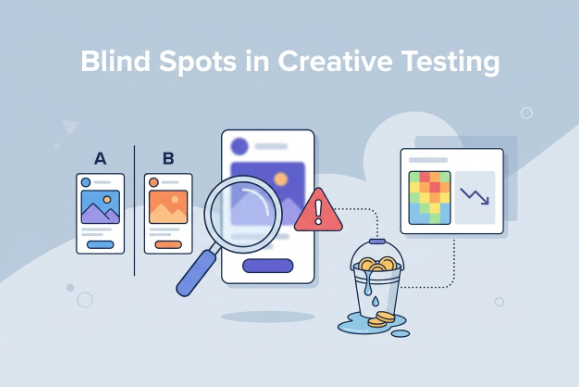
A/B tests tell you what happened, but not why it happened. A winning variant might have outperformed because of placement timing, a misleading hook, or just random noise in the sample. Teams often see a small 3–5% lift in one variant, declare a winner, and move on. They do this without understanding the comprehension gap or emotional disconnect that will cause problems at scale.
This is reactive. You’re paying with your real budget to learn things you could have discovered in a controlled, pre-launch environment. Testing before you launch catches flawed creative before you spend money amplifying the mistake.
Blind Spot #1: Are You Mistaking Clicks and Engagement for Real Intent?
High click-through rates don’t mean your message landed. Sometimes a provocative or confusing headline drives curiosity clicks; people are clicking precisely because they don’t understand. When the landing page fails to meet their expectations, conversions drop. Worse, budget gets reallocated to the “high-engagement” creative that was causing the problem in the first place.
Engagement metrics measure stopping power, not comprehension or intent. They’re useful as a directional signal, but they’re dangerous as a primary success metric.
Fix before launch: Add simple comprehension checks to your pre-launch test. Ask participants: What is this ad about? Who is it for? What does it want you to do? If their answers are wrong or vague, you’ve found a clarity problem before it costs you money.
Blind Spot #2: Are You Only Capturing What People Can Say, Not What They Actually Felt?
People rationalize. They explain their reactions after the fact, filtered through social pressure and what they think is a “reasonable” answer. But the micro-reactions (a moment of confusion, a flicker of skepticism, attention drifting from the CTA) rarely make it into a survey response.
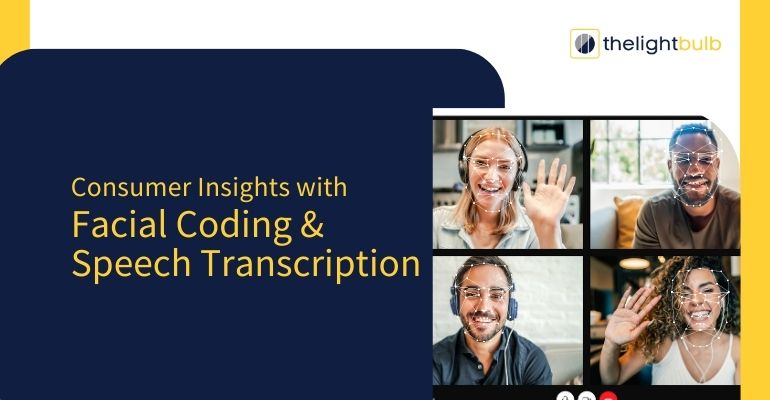
What you miss is important: the three seconds where attention shifts away from your brand logo, or the moment a voiceover causes disengagement. This is where observational data helps. Facial coding can map emotion in real time, and eye tracking generates heatmaps showing exactly where attention goes. These signals don’t replace what people say. They add another layer of evidence that’s harder to dismiss when stakeholders push back.
Fix before launch: Pair your “why” questions with observational signals. When a participant says, “I liked it,” emotion and gaze data can confirm, or even contradict, that statement.
Blind Spot #3: Is Your Test Designed to Generate Answers—or to Confirm What You Already Believe?
Asking leading questions like “Do you like this ad?” produces preference noise, not a useful diagnosis. It tells you almost nothing actionable. And testing too many variants without a clear hypothesis just turns your study into a random number generator where the “winner” may have simply gotten lucky.
Fix before launch: Write one or two specific hypotheses for each creative before you write any questions. For example: “Viewers will understand the core offer within the first three seconds,” or “This scene increases trust compared to the control.” Then, design your test to prove or disprove that specific hypothesis. This approach also makes your final report much easier to build and defend.
Blind Spot #4: Are You Testing on the Wrong Audience—or in the Wrong Context?
The validity of your test can break in two common ways. First is an audience mismatch. Your test sample might be younger or more tech-savvy than your actual buyer, so the results won’t apply in the real world.
Second is a context mismatch. You test the creative full-screen on a desktop with the audio on, but your audience will actually see it on a phone with the sound off while scrolling their feed.
Fix before launch: Define who, where, and how the creative will be consumed as part of your test specification, not as an afterthought. Match the device, sound conditions, and platform in your test setup.
Blind Spot #5: Can You Connect Creative Signals to Outcomes—or Are Attribution Blind Spots Steering Decisions?
Attribution blind spots can steer your decisions the wrong way. Inconsistent reporting across platforms can double-count or undercount a creative’s impact. Privacy changes like those from iOS have weakened the optimization loops teams used to rely on. And last-click attribution almost always undervalues upper-funnel creative, causing budgets to shift toward what’s easy to measure, not what actually builds demand.
Fix before launch: Get all stakeholders to agree on what success looks like for this creative’s specific job before the results come in. An awareness creative shouldn’t be judged on its conversion rate. Settle these measurement questions early, or you’ll spend launch week arguing about whose numbers are right.
What Does a “Fast but Defensible” Pre-Launch Creative Testing Workflow Look Like?
For most research leads, the real constraint isn’t running the test. It’s the analysis backlog that comes afterward. A three-layer model can help keep things moving:
- Quick screen: Run multiple variants through a clarity and message-takeaway check. Eliminate the obvious losers before you invest more time.
- Diagnostic deep-dive: For the finalists, use facial coding and eye tracking to see where attention and emotion shift. This is where you catch a moment of confusion or a missed call to action.
- Synthesis: Use automated tools like transcription and AI summaries to quickly find themes in qualitative data. Your output should be simple: “We expected X, we observed Y, so we recommend Z.”
To prevent backlog from building up in the first place, standardize your checklists, pre-tag common themes, and keep a simple library of creative learnings so each test builds on the last.
What Should You Change This Week to Reduce Wasted Spend on Your Next Launch?
- Replace “Do you like it?” with two comprehension checks and one diagnostic question about emotion or attention.
- Write one hypothesis for each variant before you design the questions. Cap the number of variants to what you can reasonably interpret.
- Add audience and context matching as firm requirements to your recruitment brief.
- Agree on success metrics for each funnel stage and document attribution limits before the results come in and create debate.
None of these changes require a new tool or a longer timeline. They just require a tighter process. And that’s something you can start implementing before the next brief hits your desk.