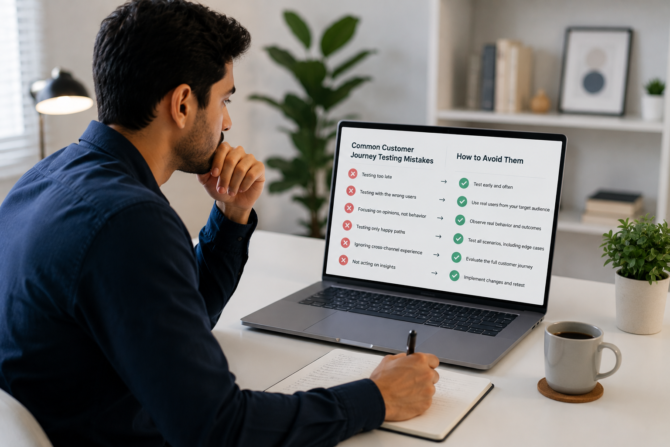
Running a customer journey study is only half the work how it’s designed, who it’s tested on, and what happens with the findings afterward determine whether the effort actually improves the business or just produces an interesting report that sits unused. The same handful of mistakes show up repeatedly across teams new to journey testing, and most of them are avoidable with a bit of foresight.
This article is part of a broader series for the full picture, see the complete guide to what a customer journey map really is.
Mistake 1: Testing With the Wrong Audience
A study is only as good as the people in it. Testing a B2B onboarding flow with a general consumer panel, or testing a enterprise-focused pricing page with respondents who don’t match the actual buyer profile, produces findings that look legitimate but don’t reflect how real prospects would behave.
How to avoid it: Define the target respondent profile as precisely as the actual buyer persona role, industry, company size, familiarity with the category before recruiting a panel, rather than defaulting to whichever sample is fastest or cheapest to reach.
Mistake 2: Testing Only One Stage of the Journey
It’s tempting to test only the homepage or the checkout page, since they’re the easiest to instrument and the most visible to leadership. But friction earlier in the journey often causes hesitation that only becomes visible several steps later, and testing a single stage in isolation can misattribute the cause.
How to avoid it: Map the full journey first, even roughly, and test connected stages together where possible, so findings at one stage can be checked against what happened earlier in the same session.
Mistake 3: Treating a Single Study as Permanent
A journey tested once, six months or a year ago, doesn’t reflect a business that has since changed its pricing, redesigned its website, or launched a new product line. Teams that treat an old study as still-current evidence are often making decisions based on a journey that no longer exists.
How to avoid it: Build journey testing into a recurring cadence tied to major changes a redesign, a pricing update, a new campaign rather than a one-time research project with no planned follow-up.
Mistake 4: Designing the Study Around What’s Easy to Measure, Not What Matters
Standard analytics make click-through and conversion rate easy to track, so testing plans often gravitate toward validating what’s already measurable rather than investigating what’s genuinely uncertain or high-risk. This produces studies that confirm existing knowledge instead of surfacing new insight.
How to avoid it: Start study design by listing the biggest unanswered questions or riskiest assumptions in the current journey, and build the study around answering those not around what’s simplest to instrument.
Mistake 5: Ignoring Emotional Signals in Favor of Behavioral Data Alone
Behavioral data clicks, time on page, scroll depth shows what happened, but not how it felt. A page can have an unremarkable bounce rate and still be quietly frustrating everyone who visits it, a signal that only shows up through facial coding or direct stated feedback.
How to avoid it: Layer emotional and stated-feedback signals (facial coding, surveys) onto behavioral data rather than relying on behavior alone, especially at stages where hesitation or confusion is suspected but not yet confirmed.
Mistake 6: Not Involving the Teams Closest to the Problem
Journey testing run entirely by one team often research or marketing without input from sales or customer support can miss context those teams already have. Sales reps often know exactly where prospects hesitate in conversations; support teams know which onboarding steps generate the most tickets. Leaving that knowledge out of study design wastes an existing source of insight.
How to avoid it: Involve sales, support, and product stakeholders early in study design, using their frontline observations to help prioritize which stages and questions the study should focus on.
Mistake 7: Collecting Data Without a Plan to Act on It
A completed study with detailed findings is only valuable if someone owns turning those findings into changes. Reports that get presented once and then archived rarely translate into actual journey improvements, no matter how rigorous the underlying research was.
How to avoid it: Assign clear ownership for acting on findings before the study begins who reviews results, who prioritizes fixes, and by when rather than treating the report itself as the finish line.
Mistake 8: Assuming B2B and B2C Journeys Need the Same Testing Approach
B2B journeys typically involve multiple stakeholders, longer consideration periods, and higher-stakes decisions than most B2C journeys. Applying a B2C-style, single-session testing approach to a B2B journey can miss the multi-visit, multi-person dynamics that actually shape the decision.
How to avoid it: Design B2B journey studies with the realistic buying process in mind accounting for return visits, multiple stakeholders, and longer timeframes rather than assuming a single linear session tells the full story.
Mistake 9: Over-Interpreting a Single Session or Respondent
It’s tempting to treat one particularly vivid session a respondent who visibly struggled, or one who breezed through effortlessly as representative of the whole audience. Individual variation is normal, and building conclusions around a single standout session risks chasing an outlier instead of a genuine pattern.
How to avoid it: Look for patterns that hold across a meaningful share of the sample before treating a finding as reliable, and use single sessions as illustrative examples rather than the basis for a decision on their own.
Why These Mistakes Are So Easy to Make
None of these mistakes come from a lack of effort they tend to happen because journey testing sits at the intersection of research methodology, business priorities, and organizational politics, and it’s easy to optimize for one at the expense of the others. A team under time pressure gravitates toward the easiest-to-measure stage. A team without cross-functional buy-in tests in isolation from sales and support. A team without a clear findings owner produces a report that never becomes action.
Recognizing that these mistakes are structural, not just individual oversights, is what makes it possible to build a testing process clear ownership, cross-functional input, a recurring cadence that avoids them by design rather than by vigilance alone.
How to Catch These Mistakes Before a Study Launches
A short pre-launch checklist can catch most of these issues before they affect results:
- Does the respondent panel actually match the target buyer profile?
- Does the study cover connected stages, not just the easiest one to measure?
- Is this a one-time study, or is a follow-up cadence already planned?
- Does the study combine behavioral, emotional, and stated-feedback data, or rely on just one signal?
- Have sales, support, or product stakeholders reviewed the study design?
- Is there a named owner for acting on the findings once the study is complete?
Running through this list before launching a study is far cheaper than discovering these gaps after the data has already been collected.
Conclusion
Most customer journey testing mistakes come down to the same root cause: designing a study around convenience rather than the questions that actually matter. Avoiding the wrong-audience trap, testing connected stages instead of isolated ones, combining behavioral and emotional signals, and assigning clear ownership for findings are what separate a study that changes the business from one that just produces a report.
To design a study that avoids these pitfalls from the start, request a demo of TheLightbulb.ai’s Insights Pro, or read the complete guide to customer journey maps.
Frequently Asked Questions
What’s the most common mistake teams make in their first customer journey study?
Testing only the most visible, easiest-to-measure stage usually the homepage or checkout while leaving earlier or later stages, where real friction often originates, untested.
How do you avoid recruiting the wrong respondent panel?
Define the target respondent profile with the same precision as an actual buyer persona role, industry, company size, familiarity with the category before recruitment begins, rather than defaulting to a general or convenient sample.
Why does emotional data matter if behavioral data already shows conversion rates?
Behavioral data shows what happened; emotional data shows how it felt. A page can convert acceptably while still frustrating a meaningful share of visitors, a gap only emotional and stated-feedback signals reveal.
How often should a customer journey study be repeated?
Whenever a major change occurs a redesign, pricing update, or new campaign and at minimum on a recurring cadence rather than as a single, one-time project.
Who should be responsible for acting on journey testing findings?
A named owner assigned before the study begins, ideally with clear authority to prioritize and implement fixes, rather than leaving the findings to be interpreted informally after the fact.
Is it a mistake to draw conclusions from a single standout respondent session?
Yes, on its own. A single session can illustrate a finding well, but conclusions should be based on patterns that hold across a meaningful share of the sample, not one particularly memorable respondent.
Can these mistakes happen even with a well-funded, professionally run study?
Yes most of these mistakes are structural rather than about budget or rigor, which is why building clear ownership, cross-functional input, and a recurring cadence into the process matters as much as the study’s technical quality.