
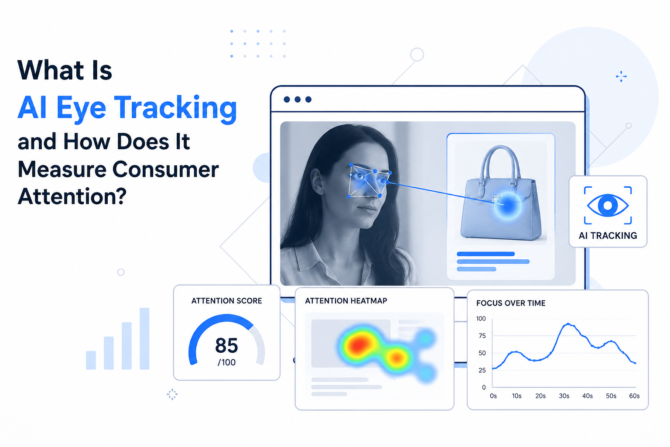
What Is AI Eye Tracking and How Does It Measure Consumer Attention?
In a digital economy dominated by fleeting visual real estate, capturing attention is only half the battle; understanding how and why attention converts into engagement is what separates high-performing brands from the rest. Staring at a screen does not mean paying attention. For decades, legacy market research relied on traditional eye tracking that required cumbersome hardware, infrared chin rests, and artificial lab settings, severely limiting sample sizes and ecological validity. Meanwhile, standard self-reported surveys suffer from recall bias and social desirability effects.
The modern paradigm has shifted toward AI eye tracking the remote, webcam-based evolution that scales visual attention and emotion measurement. By decoding subconscious visual fixations, saccades, and micro-expressions via standard web consumers’ webcams, brands unlock research-grade data without physical labs. Operating as a remote-first Emotion AI SaaS platform, technology like TheLightbulb.ai empowers enterprises to capture unstated consumer responses at true online scale.
This comprehensive guide explores the core mechanics of AI eye tracking, how it measures visual attention, and how foundational attention insights power everything from digital advertising and brand visibility to full-funnel customer journey optimization.
Defining AI Eye Tracking: Beyond the Physical Lab
To understand how modern visual measurement works, we must first look past legacy hardware constraints. Traditional eye-tracking studies were restricted to expensive, 10-person physical labs using infrared table-mounted devices or bulky wearable glasses. These setups introduced artificial bias and limited testing speed.
AI eye tracking replaces physical infrared hardware with advanced deep learning models and computer vision operating directly inside standard web browsers.
How Webcam-Based Tracking Works
By mapping facial landmarks, estimating head pose in real time, and tracking gaze vectors securely and privately, modern algorithms calculate precisely where a user is looking on a digital screen. Because this process runs entirely through standard consumer webcams, brands can reach thousands of global respondents across natural home environments.
Global research leaders and enterprise brands such as Amazon, Myntra, Swiggy, Nielsen Media, Kantar, and NIQ leverage remote behavioral technologies to bypass lab bottlenecks, achieving rapid, statistically robust consumer insights.
The Science of Gaze: Fixations, Saccades, and Heatmaps
Human visual processing is an intricate dance of rapid eye movements and micro-pauses. When evaluating digital interfaces, ads, or packaging, the human eye does not glide smoothly; it jumps.
1. Fixations
Fixations represent the moments when visual interest settles and the brain actually processes information. Measuring fixation duration is crucial for analyzing high-impact zones like headlines, product packaging, and pricing tables.
2. Saccades
Saccades are the rapid jumps between fixations that indicate the path of visual discovery. Smooth saccadic flow reflects high cognitive ease, whereas erratic jumps signal user confusion or friction.
3. Visual Heatmaps
By aggregating gaze data across user cohorts, platforms generate visual heatmaps that instantly highlight hot zones (high attention areas) and blind spots (zero engagement areas).
Beyond Gaze — The Emotion AI Connection
Gaze alone tells you where someone looked, but it does not reveal how they felt. Did they gaze at a prominent element out of delight or confusion? Platforms bridge this gap by combining visual attention tracking with unstated, non-verbal emotional responses. By reading micro-expressions and facial muscle movements, Emotion AI decodes cognitive load, valence, and arousal in real time.
Connecting Foundational Attention to Digital Formats & Channels
Foundational gaze metrics serve as the building blocks for multi-channel optimization across digital touchpoints.
A. Advertising Performance & Brand Salience
In digital advertising, the first three seconds dictate whether an ad succeeds. Through AI eye tracking for advertising, brands measure what people actually notice in real time, isolating initial hooks and drop-off points. Furthermore, ensuring brand salience prevents logos and product identifiers from getting lost in visual clutter, protecting media investments and maximizing recall.
B. UX, Website Conversion, and Video Ads
Why do high-traffic web pages experience low conversions? Often, it is due to CTA blindness where users’ mental filters cause them to bypass standard calls-to-action. Attention heatmaps diagnose UI/UX friction to optimize conversion rates. Similarly, tracking second-by-second drop-offs through AI eye tracking for video ads captures dynamic attention across narrative arcs.
Scaling Insights Across the Customer Journey & Market Research
Consumer behavior spans complex, omnichannel ecosystems that require end-to-end analytical rigor.
A. Journey Research Across B2C & B2B
- B2C Customer Journey Research: Pinpoints attention fatigue and friction across omnichannel consumer touchpoints, from social discovery to mobile checkout.
- B2B Buyer Journeys & Digital Experiences: Decodes complex information hierarchies in SaaS portals, whitepapers, and pricing pages where enterprise buyers evaluate long-form information differently than retail shoppers.
B. Modernizing Market Research & Strategic Business Decisions
Traditional focus groups are increasingly vulnerable to facilitator and peer bias. By modernizing market research with webcam-based Emotion AI, agencies and enterprises gain objective behavioral tracking at scale. Executive leadership at companies like Amazon, Myntra, and Swiggy leverage these deep insights to make data-backed marketing decisions before committing heavy media spend.
Conclusion & Strategic Outlook
Understanding what consumers look at and feel is no longer a luxury lab experiment restricted by physical hardware; it is an accessible, webcam-based scalable standard. By decoding subconscious visual attention and emotional resonance, brands can eliminate guesswork and build high-impact customer experiences.
Ready to transform how your business measures visual attention? Explore how TheLightbulb.ai turns remote Emotion AI into your ultimate competitive advantage.
Frequently Asked Questions (FAQs)
1. What is AI eye tracking, and how does it work without special hardware?
AI eye tracking uses advanced computer vision and deep learning models running in standard web browsers. By analyzing facial landmarks, head orientation, and gaze vectors via a standard user webcam, the software maps visual fixations and heatmaps without requiring infrared equipment, glasses, or physical labs.
2. How accurate is webcam-based eye tracking compared to traditional lab equipment?
Modern remote AI eye tracking achieves high-precision calibration that correlates strongly with traditional laboratory equipment. Because it operates at online scale across thousands of diverse participants in natural home settings, it offers superior ecological validity compared to small, artificial lab samples.
3. Can AI eye tracking also measure emotional response?
Yes. Platforms like TheLightbulb.ai combine visual attention metrics (gaze paths and fixations) with Emotion AI, which analyzes unstated, non-verbal facial micro-expressions to gauge genuine emotional valence and engagement in real time.
4. How does foundational visual attention data integrate into market research and marketing decisions?
It replaces biased self-reported surveys with objective behavioral data. Brands and market research agencies use these insights to pre-test ads, optimize website UI/UX, refine video content, and validate strategic decisions prior to major campaign launches.