How Is Emotion AI Used in Advertising Testing and Creative Evaluation?
Most ad pre-tests end with a handful of scores: liking, brand recall, message clarity, intent. Those scores tell a team whether an advert works overall. They rarely tell the team which second is working and which is not.
Emotion AI advertising testing adds that missing timeline. By analysing visible facial activity and, where the setup supports it, eye movements while people watch, researchers can see how response and attention change scene by scene. For the broader context, see how Emotion AI helps businesses understand customers.
Direct answer: Emotion AI is used in advertising testing to measure how viewers visibly respond, and where they look, at each moment of an advert, trailer or creative sequence. Facial coding tracks changes in visible response; eye tracking shows visual attention. Researchers combine these timelines with survey scores to find strong scenes, weak sections and missed brand moments, then refine the creative.
What creative assets can be tested with Emotion AI?
Almost any creative asset that participants view on a screen can be tested. Common examples include:
- Video adverts for TV, online video and social platforms.
- Trailers and episodes for film, streaming and broadcast content.
- Animatics and storyboards before full production.
- Static ads and key visuals, often tested with eye tracking.
- Ad concepts and scripts, which overlap with concept testing before a product launch.
- Packaging shown in ads or on shelf, covered in Emotion AI in packaging research.
Testing earlier usually saves more money, because changes to an animatic cost far less than re-shooting a finished film.
How does facial coding work in ad testing?
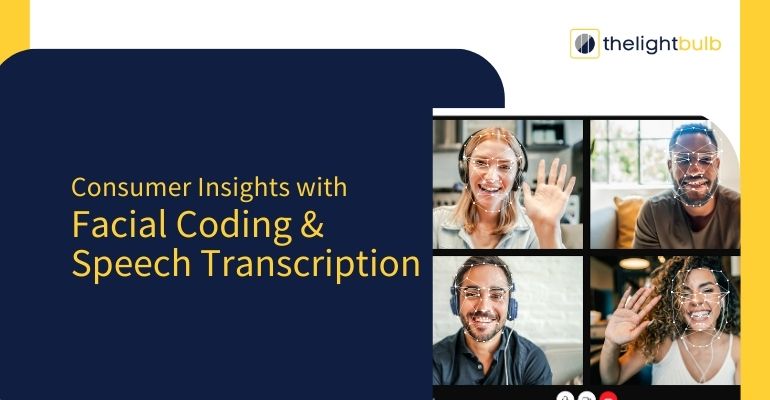
Facial coding works in ad testing by tracking visible facial activity frame by frame while participants watch, then aggregating it across the sample into a response curve aligned with the ad’s timeline.
The curve typically shows:
- Peaks where visible positive response or surprise rises, such as a joke landing or a product reveal.
- Troughs or flat sections where responsiveness falls, which often line up with slow exposition or dense information.
- Shifts at transitions, such as the move from story to brand message.
The method builds on the Facial Action Coding System, which describes facial muscle movements. As with all facial analysis, the curve shows observable response, not a definitive emotional state. Group patterns are more meaningful than any one viewer. For more on the mechanics, see facial coding in product research.
What does eye tracking add to creative evaluation?
Eye tracking adds evidence of visual attention: what viewers looked at, in what order and for how long.
Research by Michel Wedel and Rik Pieters on eye tracking in visual marketing describes eye movements as closely tied to visual attention, which makes gaze a strong indicator of what a viewer processes on screen. In ad testing, this helps answer practical questions:
- Did viewers notice the logo, or was it competing with an actor’s face?
- Was the on-screen offer read before it disappeared?
- Did the product appear where viewers were already looking?
Combining gaze with facial response is powerful. A scene can show strong visible response while the brand sits outside the viewer’s gaze. That pattern suggests the ad entertains but may not build brand memory.
What does an Emotion AI ad test look like in practice?
A typical study runs in five stages:
- Brief. Define what the ad needs to achieve and which moments matter, such as the brand reveal or the offer.
- Field. Participants watch the ad on their own device, with consent for webcam recording.
- Measure. Facial coding, and eye tracking where used, are captured during viewing; surveys follow straight after.
- Analyse. Response and attention curves are mapped scene by scene, then compared with survey scores and open comments.
- Refine. The team edits, re-sequences or re-tests specific scenes.
Open comments add essential context. Speech or text analysis can show why a scene landed, which the curves alone cannot.
How do teams turn findings into better creative?
Teams turn findings into better creative by making targeted changes to specific moments, then re-testing.
Typical edits include:
- Moving the brand earlier when response peaks before the logo appears.
- Shortening flat sections where attention and responsiveness drift.
- Placing the offer where viewers look, based on gaze patterns.
- Choosing between cut-downs for 6-, 15- and 30-second formats, keeping the scenes that carry the strongest response.
- Comparing two endings and keeping the one with clearer brand attention.
The same logic applies to the shopping moment that follows an ad, explored in emotional triggers behind purchase decisions, and to what happens when viewers click through to a landing page, explored in spotting user frustration in website and app testing.
Why not rely on survey scores alone?
Survey scores alone describe the whole ad, not its parts. Viewers typically remember peaks and endings better than the middle, so an overall rating can hide a weak section.
People may also give a favourable rating to an ad they found pleasant but forgettable. Observed response helps separate liking from attention. This is the central idea in Emotion AI vs traditional market research and the companion piece on reactions that surveys often miss.
Attention and engagement need their own definition as research measures. That is covered in measuring customer engagement with facial expression analysis.
What are the limits of Emotion AI in advertising?
The main limits concern interpretation and prediction.
- No guaranteed outcomes. Strong visible response during testing does not guarantee in-market performance or sales. Media spend, targeting, competition and timing all play a part.
- Expressions are context-dependent. A 2019 review by Barrett and colleagues showed that facial movements are not reliable, specific signals of particular emotions across people and situations. A laugh at a joke is not the same as liking the brand.
- Viewing context differs. A test on a laptop differs from a phone in a busy feed.
- Recording quality matters. Lighting, camera angle and participant expressiveness all affect results.
Used with these limits in mind, Emotion AI is a strong diagnostic tool rather than a scorecard.
How does TheLightbulb.ai support creative testing?
Creative testing is a core use case of Insights Pro Quantitative. According to TheLightbulb.ai’s website, it covers advertisements, concepts, trailers, episodes, and packaging or shelf designs. Studies can draw on the company’s facial coding, eye tracking, speech transcription, text sentiment and survey technologies, with access to global online panels and an in-house customer insight research team.
The practical benefit for an ad team is a scene-level view of response and attention, paired with stated feedback from the same viewers.
Conclusion
Emotion AI advertising testing gives creative teams something survey scores cannot: a moment-by-moment view of how viewers visibly respond and where they look. Facial coding shows changes in response. Eye tracking shows attention. Surveys and comments explain the reasons.
Together, they turn “the ad tested well” into a precise edit list: move the brand, cut the slow section, place the offer where eyes already are. That precision is where most of the value lies.
Frequently asked questions
Can Emotion AI predict if an ad will increase sales?
No. It shows how viewers responded during testing. Sales depend on many other factors, so test results should guide creative decisions rather than predict revenue.
What is a response curve in ad testing?
It is a timeline showing how visible response, aggregated across viewers, changes second by second during an advert.
Is eye tracking necessary for ad testing?
No, but it helps. Facial coding shows changes in response; eye tracking shows whether viewers looked at the brand, product or offer at that moment.
Can Emotion AI test static ads?
Yes. Static ads are often evaluated with eye tracking to see what viewers notice first, alongside surveys and, where relevant, facial response.
How early should ads be tested?
As early as practical. Testing animatics or storyboards lets teams fix problems before expensive production.