How Can Emotion AI Help Brands Understand Consumer Responses to Product Packaging?
A pack has seconds to do its job. On a crowded shelf or a scrolling product grid, it must be noticed, recognised and understood before the shopper moves on. Most packaging research asks people afterwards what they thought. By then, the first few seconds, which often matter most, are already a blur.
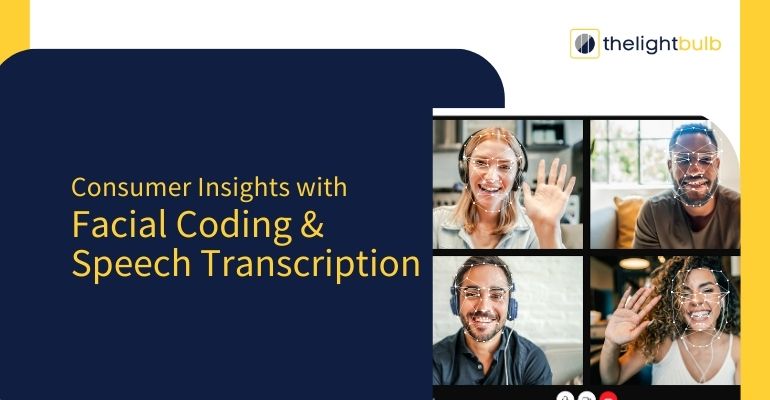
Emotion AI packaging research looks at those seconds directly. Eye tracking shows where shoppers look first and what they skip. Facial coding shows how visible response changes as they take the pack in. For the foundations of these methods, see how Emotion AI helps businesses understand customers.
Direct answer: Emotion AI helps brands understand consumer responses to packaging by recording, with consent, where participants look and how their visible facial response changes while they view a pack or shelf. Researchers compare designs on attention to key elements, such as brand, variant and claims, and on observed response, then check these against stated preference to guide design decisions.
Why is packaging hard to research with surveys alone?
Packaging is hard to research with surveys alone because its effect often happens in a glance, before people form opinions they can describe.
Asked directly, participants tend to judge packaging like art critics: they comment on whether it looks attractive. In a real shopping moment, the questions are different. Did they find it? Did they recognise the brand? Did they understand the variant? Those are questions about attention and processing, which are hard to recall accurately afterwards.
This does not make survey responses wrong. It means they capture a considered judgement rather than the first moments of contact, a theme covered in reactions that surveys often miss.
How does eye tracking help evaluate packaging?
Eye tracking helps evaluate packaging by showing which elements attract attention, in what order and for how long.
Marketing researchers Michel Wedel and Rik Pieters describe eye movements as tightly coupled with visual attention, and they have studied how consumers search shelves and product displays. Applied to packaging, gaze data can answer practical questions:
- Findability. How quickly do participants locate the pack on a shelf?
- Hierarchy. Do they see the brand, then the variant, then the claim, as intended?
- Neglected areas. Which claims or icons are rarely looked at?
- Competition. Does a neighbouring pack pull attention away?
Where the research setup supports it, results are often summarised as heatmaps or gaze sequences for each design.
What does facial coding add to packaging research?
Facial coding adds evidence of how visible response changes while participants view the pack.
For example, a premium redesign may draw strong attention but show visible puzzlement when participants reach the variant name. Or a bold colour change may produce an early visible response that participants later describe as “too different” in the survey. Neither signal is a final answer. Each shows where to probe.
The method relies on detecting facial muscle movements, building on the Facial Action Coding System. As in any application, the observed response is an indicator. Its meaning comes from context and comparison. For a fuller explanation of the technique, see facial coding in product research.
Which design elements should a packaging study examine?
A packaging study should examine the elements that carry the pack’s job. These are research considerations, not guaranteed emotional triggers.
| Element | What to look for | Example question |
| Visual hierarchy | Order in which elements are seen | Is the brand seen before the claim? |
| Colour | Findability and category cues | Does the new colour stand out without confusing the variant? |
| Typography | Readability at a glance | Can participants read the variant name quickly? |
| Imagery | Attention and visible response | Does the food image draw attention to taste? |
| Claims and icons | Whether they are noticed | Is the “recyclable” icon seen at all? |
| Structure and shape | Shelf presence | Does the pack’s outline aid recognition? |
A design element that draws attention and visible response may still fail to drive choice. That distinction is explored in emotional triggers behind purchase decisions.
How do you run a packaging test with Emotion AI?
You run a packaging test with Emotion AI by exposing participants to realistic pack and shelf views, recording attention and response, and then asking about preference and understanding.
- Prepare stimuli. High-quality pack images, and ideally a realistic shelf or product grid with competitors.
- Define tasks. For example: “Find the low-sugar variant of Brand X.”
- Record with consent. Eye tracking and facial coding run during the task.
- Ask questions. Preference, brand recognition, variant understanding and claim recall.
- Compare designs. Look at time to find, attention to key elements and observed response alongside stated scores.
- Refine and retest. Adjust the weakest elements and run the test again.
Testing packs within early concepts is also possible, as explained in concept testing before a product launch. The same approach applies to packs featured in adverts, discussed in creative evaluation with Emotion AI.
What are the limits of Emotion AI for packaging?
The main limits involve interpretation and realism.
- Faces don’t map neatly to feelings. A 2019 review by Barrett and colleagues found that facial movements are not reliable or specific indicators of particular emotions across people and contexts.
- Screen versus store. A virtual shelf on a laptop differs from a physical aisle with lighting, height and movement.
- Attention is not preference. A pack can draw the eye and still be rejected. This is why engagement and choice are kept separate, as discussed in engagement signals in research.
- Recording quality. Lighting and camera position affect both facial and gaze data.
Teams should report results as comparative evidence between designs, not as predictions of sales.
How should brands combine packaging findings with other data?
Brands should read attention, observed response and stated feedback together. This mixed approach is the core idea in Emotion AI vs traditional market research.
The strongest decisions come when the evidence converges. If a new design is found faster, its variant name is read more often, and participants also say it is clearer, the case for change is strong. Where evidence diverges, a follow-up study or qualitative session can clarify.
Packaging also has a digital life. Product images on e-commerce pages need testing too, and checkout flows can be examined using usability testing with facial coding.
How does TheLightbulb.ai support packaging research?
Packaging and shelf designs are one of the creative testing use cases named on Insights Pro Quantitative. According to TheLightbulb.ai’s website, these studies can draw on facial coding and eye tracking, together with speech transcription, text sentiment and market surveys, plus global online panels and an in-house customer insight research team.
This allows a brand to compare designs on observed attention and response alongside what participants say in the same study.
Conclusion
Emotion AI packaging research helps brands understand the first seconds of contact with a pack: where eyes go, what gets missed and how visible response changes as shoppers take it in. Paired with stated preference and comprehension questions, it turns subjective design debates into evidence about specific elements.
It cannot promise that a pack will sell. It can show whether the brand is found, the variant understood and the key claim noticed, which are the jobs good packaging needs to do.
Frequently asked questions
Can Emotion AI test packaging before it is printed?
Yes. Pack designs can be tested as digital images or on virtual shelves, so changes can be made before printing.
What is a packaging heatmap?
It is a visual summary of eye-tracking data showing which areas of a pack received the most visual attention across participants.
Does a colourful pack always perform better?
No. Colour can aid findability, but it can also blur category or variant cues. Testing shows how a specific design performs against competitors.
Is shelf testing better than testing a pack on its own?
Yes, for findability and competitive questions. Single-pack tests are still useful for reading claims and understanding design details.
Can facial coding tell which pack shoppers prefer?
No, not on its own. It shows observed response during viewing. Preference comes from asking and from choice tasks.