How Does Facial Expression AI Analyse Customer Reactions During Product Testing?
Product testing has always relied on two sources of evidence: what participants do and what they say afterwards. Both matter. Both also miss the moment-by-moment reaction that happens while someone first encounters a feature, a demo or a price point.
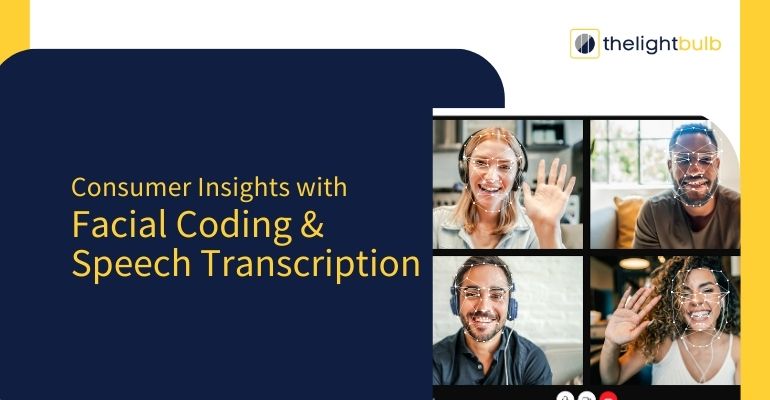
Facial expression AI in product testing helps fill that gap. It analyses visible facial activity, recorded with consent, as participants interact with a product, prototype or product presentation. The result is a time-stamped record of where responses changed, which researchers then interpret alongside verbal feedback and task observations.
Direct answer: Facial expression AI analyses customer reactions during product testing by detecting visible facial muscle movements frame by frame on webcam video, linking them to the exact moment in the test, and summarising patterns across participants. Researchers use these patterns to locate moments of interest, confusion or indifference, then check them against what participants say and do.
What is facial expression AI?
Facial expression AI is software that detects and classifies visible facial movements in video. It is the automated form of facial coding, which researchers have long done by hand.
Most systems draw on the Facial Action Coding System (FACS), published by Paul Ekman and Wallace Friesen in 1978 and updated in 2002. FACS describes facial activity as individual action units, such as a brow raise or a lip-corner pull. It was built to record movement without assigning emotional meaning. Automated tools speed this up, then apply models that group movements into indicators such as positive response, surprise or concentration.
That last step is an inference. For the wider picture of how these signals become consumer insight, start with what Emotion AI means in market research.
What kinds of product tests can it support?
Facial expression AI can support any product test where the participant faces a camera while engaging with a stimulus. Common formats include:
- Product demo videos, where viewers watch features being shown.
- Digital prototypes, such as a new app screen or configurator.
- Product presentations, including feature lists, pricing and comparison tables.
- Unboxing or first-use videos, which simulate the first encounter.
- Early concepts, before anything is built. This overlaps with concept testing before a product launch.
Physical, in-hand testing is harder to capture with a webcam, because people look down and move. In those cases, researchers often use video of the product or a controlled presentation instead.
How does the analysis work, step by step?
The analysis works by aligning facial signals with the timeline of the product test, then comparing patterns across many participants.
- Set up the stimulus. The team defines what participants see and the tasks they complete, with clear time markers for each feature or screen.
- Record with consent. Participants agree to webcam recording. Good lighting and a frontal camera angle improve signal quality.
- Detect facial activity. The software identifies the face and tracks movements across frames.
- Infer response indicators. Models translate movement patterns into indicators, such as visible positive response or signs of puzzlement.
- Aggregate. Results are averaged across participants so that one person’s habits do not dominate.
- Interpret. Researchers review peaks and drops against specific moments, then read the matching verbal comments.
The aggregation step is important. Individuals differ widely in how expressive they are. Group-level patterns at a specific moment are far more meaningful than one participant’s face.
What can facial signals reveal during a product test?
Facial signals can reveal when a visible response changed, which helps researchers decide where to look more closely.
Typical findings include:
- A spike of visible interest when a particular feature appears.
- Flat or declining responsiveness during a long explanation.
- Brow lowering or lip tightening during a pricing slide, which may signal concentration, scepticism or simple reading effort.
- Different patterns between segments, such as new users versus existing customers.
Notice the cautious wording. A lowered brow might mean confusion, or it might mean careful thought. The signal points to a moment worth examining; the explanation comes from additional evidence. This idea of engagement as a measurable but limited signal is developed further in measuring customer engagement with facial expression analysis.
Why combine facial signals with other evidence?
Facial signals need other evidence because they show that something happened, not why it happened.
A strong product test combines at least three layers:
| Evidence | What it shows | Example |
| Facial signals | Moment-by-moment visible response | Visible response drops at the subscription price |
| Verbal or written feedback | Participants’ stated reasons | “I expected this to be a one-time purchase” |
| Task behaviour | What participants actually did | Several participants revisited the plan comparison |
Together, these suggest a pricing-model expectation, not a dislike of the product. Facial data alone could never support that conclusion. Where gaze data is available, eye tracking adds a fourth layer showing what participants looked at during the drop.
This multi-source approach is the core argument of Emotion AI vs traditional market research, and it explains why facial analysis often surfaces the gap between what people say and show.
What are the limits of facial expression AI in product testing?
The main limit is that facial expressions do not map neatly onto specific emotions. A 2019 review by Barrett and colleagues found that facial movements vary considerably across people, situations and cultures, so a given expression cannot be read as proof of a given feeling.
Other practical limits include:
- Recording conditions. Poor lighting, glasses glare or off-angle cameras reduce signal quality.
- Low expressiveness. Many people show little facial movement when alone at a screen.
- Task effects. Reading dense text naturally produces concentration-like activity.
- No link to satisfaction on its own. A visible positive response to a feature does not prove the product will satisfy customers in real use.
Good practice is to treat facial results as a guide to where the questions are, and to report them with this context.
How can businesses use the findings?
Businesses can use the findings to prioritise what to change, test again and probe further.
- Feature prioritisation. If several features show weak visible response and weak stated interest, they may be poor candidates for launch messaging.
- Demo editing. Sections where responsiveness drops can be shortened or re-sequenced.
- Pricing presentation. Moments of visible hesitation at the price can prompt clearer framing, then a retest.
- Purchase research. Features that draw strong positive responses can be explored further as possible emotional drivers of buying behaviour.
The same method extends beyond the product itself:
- The product’s advertising, covered in testing ads with facial coding.
- The product’s pack, covered in testing packaging and shelf designs.
- The online buying journey, covered in usability testing with facial coding.
How does TheLightbulb.ai support product testing research?
TheLightbulb.ai’s facial coding technology is designed to monitor expressions and map engagement and distraction for market research, according to the company’s website. It forms part of a wider set of technologies that also includes eye tracking, speech transcription, text sentiment and surveys.
For product research, Insights Pro Quantitative supports creative testing of concepts and product-related content, alongside global online panels and an in-house customer insight research team. For discussion-based product research, Insights Pro Qualitative supports AI-assisted analysis of focus groups and interviews.
Conclusion
Facial expression AI in product testing gives researchers a moment-by-moment view of how participants visibly respond to features, demos, prices and prototypes. Its strength is precision in time: it shows exactly where responses rose or fell.
Its weakness is that it cannot explain those changes on its own. The most useful product tests therefore combine facial signals with verbal feedback, task behaviour and, where possible, gaze data. Used this way, facial analysis turns a long test session into a short list of moments that deserve attention.
Frequently asked questions
Can facial expression AI tell if customers like a product?
No, not on its own. It shows visible responses at specific moments, which researchers compare with stated feedback and behaviour before drawing conclusions about liking.
Does facial expression analysis work with physical products?
Yes, with limits. Webcam-based analysis works best when participants face the camera, so physical products are usually shown through video or controlled presentations.
How many participants are needed for facial coding in product tests?
It depends on the study design. Because individuals vary in expressiveness, researchers rely on group-level patterns, so quantitative studies typically use larger samples than one-to-one usability sessions.
Is facial coding the same as facial recognition?
No. Facial recognition identifies who a person is. Facial coding analyses how the face moves, to understand responses during a research task.
What should a product team do with a sudden drop in visible response?
Treat it as a prompt to investigate. Review what was on screen at that moment, read participants’ comments, and check task behaviour before changing the product.