Emotion AI vs. Traditional Market Research: What Can Businesses Learn Beyond Surveys?
Surveys, focus groups and interviews have guided business decisions for decades. They remain essential. Yet most research teams have seen a result that did not hold up in the market: a concept that scored well but sold poorly, or an advert that tested “fine” but failed to hold attention.
The question in Emotion AI vs traditional market research is not which method wins. It is what each method can and cannot see, and what a business learns when it uses both. If you are new to the technology, start with the role of Emotion AI in consumer understanding.
Direct answer: Traditional market research captures what people consciously report: preferences, reasons, recall and intent. Emotion AI adds a record of how they visibly responded in the moment, using facial coding, eye tracking and language analysis. Businesses learn the most when they compare the two, because agreement adds confidence and disagreement shows exactly where to investigate.
What does traditional market research do well?
Traditional market research does well at capturing conscious opinion, reasons and intentions at scale.
Its core methods each have clear strengths:
- Surveys and questionnaires measure stated preference, awareness and intent across large, representative samples.
- Focus groups surface language, beliefs and social dynamics around a category.
- In-depth interviews explore motivations and context in detail.
- Observation and usage data show what people actually do.
These methods answer questions that Emotion AI cannot answer at all. Only asking people tells you why they switched brands, what they expected to pay or which competitor they considered. Any honest comparison starts there.
What can surveys miss?
Surveys can miss moment-to-moment reactions and responses that people cannot or will not put into words.
Three well-documented issues explain most of the gap:
- Recall limits. A participant asked about a 30-second advert after it ends reports an overall impression. The moment their attention dipped at second 14 is rarely remembered.
- Social desirability. A literature review by Ivar Krumpal found that survey respondents tend to under-report socially undesirable behaviour and over-report desirable behaviour, especially on sensitive topics.
- Limited self-insight. People are not always aware of what influenced their attention or reaction, so their stated reasons may be reconstructed after the fact.
None of this makes surveys unreliable. It means survey data is retrospective and filtered through the respondent’s own interpretation. The companion article on reactions that surveys often miss explores these examples in depth.
What does Emotion AI add?
Emotion AI adds time-stamped, observed evidence of response during exposure to a stimulus.
The main technologies contribute different layers:
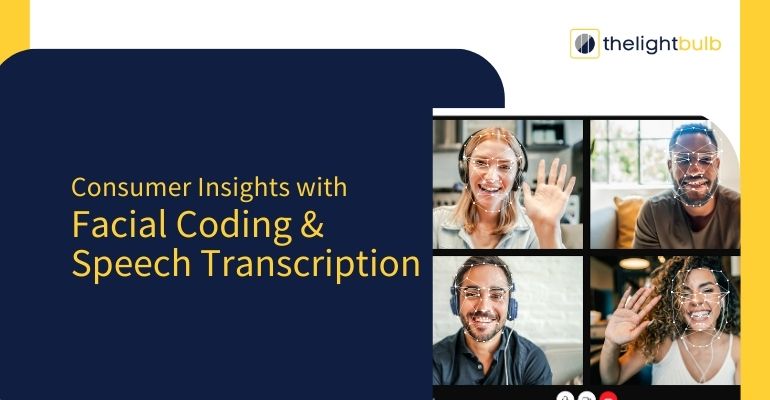
- Facial coding detects visible facial activity and infers response indicators. See facial coding in product research.
- Eye tracking shows where attention went and in what order.
- Speech transcription and text sentiment turn open comments into structured, analysable data.
The key word is during. A survey asks after the experience; Emotion AI records within it. That is why the two complement each other rather than compete.
How do the methods compare side by side?
The methods differ mainly in timing, type of evidence and what each can explain.
| Dimension | Traditional research (surveys, groups, interviews) | Emotion AI (facial coding, eye tracking, sentiment) |
| Type of evidence | Stated: what people say they think or will do | Observed: visible response and attention during exposure |
| Timing | After or around the experience | Moment by moment during the experience |
| Explains “why” | Yes, through reasons and probing | Not on its own; shows where to probe |
| Sensitive to recall and social pressure | Yes | Less directly, though behaviour is still observed |
| Sensitive to recording conditions | No | Yes (lighting, camera angle, expressiveness) |
| Best for | Preference, intent, reasons, segmentation | Locating peaks and drops, attention, creative diagnostics |
Neither column is complete. The table shows why mixed-method designs are becoming standard in creative, product and UX research.
What happens when stated and observed results disagree?
When stated and observed results disagree, the disagreement itself becomes the most useful finding.
Consider three patterns:
- High stated score, low observed response. Participants rate an advert well, but visible engagement fades in the middle. The ad may be likeable overall yet have a weak section. The fix may be an edit, not a new campaign. Our guide to creative evaluation with Emotion AI covers this case.
- Low stated score, strong observed response. Participants dismiss a bold pack design in the survey, but it draws early gaze and visible interest. The design may be attention-grabbing but unfamiliar. See Emotion AI in packaging research.
- Both low at the same moment. A pricing screen shows visible hesitation and generates negative comments. That convergence is strong evidence of a real problem.
In each case, the comparison tells researchers where to look and what to ask next.
How should businesses combine the two approaches?
Businesses should design studies where stated and observed data come from the same participants and the same stimulus.
A practical structure:
- Expose participants to the advert, concept, pack or website while recording facial activity and, where relevant, gaze.
- Ask survey questions immediately afterwards, covering liking, clarity and intent.
- Collect open comments, then analyse them with transcription and sentiment tools.
- Align everything on one timeline and compare stated scores with observed peaks and drops.
- Probe the moments of disagreement in follow-up questions or qualitative sessions.
This structure works across use cases:
- Early-stage concept evaluation, where ideas are compared before development.
- Purchase-related emotional responses, where stated reasons and observed attention often differ.
- Engagement signals in research, where content runs over time.
- Facial expression AI in UX research, where friction appears during tasks.
What are the limitations of Emotion AI compared with surveys?
Emotion AI’s main limitation is interpretation. A 2019 scientific review led by Lisa Feldman Barrett concluded that facial movements are not reliable or specific enough across people, contexts and cultures to be read as definitive signs of particular emotions.
In practice, this means:
- Emotion AI cannot report reasons or intentions; only people can.
- It depends on video quality and participant expressiveness.
- It needs careful consent and data handling, since it involves video of faces.
- It should never be used to label an individual’s feelings with certainty.
Surveys have their own limits, described above. Each method’s weakness is partly covered by the other’s strength, which is the strongest argument for using both.
How does TheLightbulb.ai bring both approaches together?
TheLightbulb.ai’s website describes a platform that combines facial coding, eye tracking, speech transcription, text sentiment and generative AI with market surveys. This allows stated and observed responses to be collected within the same project.
Insights Pro Quantitative supports quantitative studies with Emotion AI, global online panels and an in-house research team, covering creative, UI/UX and customer journey testing. Insights Pro Qualitative brings AI-supported analysis to online focus groups and interviews, where conversation and observed response can be reviewed together.
Conclusion
Emotion AI vs traditional market research is a false contest. Surveys and interviews explain what people think and why. Emotion AI shows how they visibly responded, moment by moment, while the experience was happening.
Businesses learn beyond surveys by putting both kinds of evidence side by side. Where they agree, confidence rises. Where they disagree, the research has found a specific moment to fix or explore. That combination leads to fewer surprises after launch.
Frequently asked questions
Is Emotion AI more accurate than surveys?
No. They measure different things. Surveys capture stated opinion; Emotion AI captures observed response. Neither is a more accurate version of the other.
Can Emotion AI replace focus groups?
No. Focus groups explore reasons, language and social context. Emotion AI can enrich focus group analysis by adding observed response to the discussion.
When should a business add Emotion AI to a survey study?
Add it when the decision depends on reactions to something people see or use, such as an advert, pack, concept or website, and timing within the experience matters.
Does Emotion AI remove survey bias?
No. It adds evidence that is less dependent on recall and self-reporting, but it brings its own interpretation limits. Combining methods reduces blind spots rather than removing bias.
What is a mixed-method market research study?
It is a study that combines different types of evidence, such as surveys, facial coding and eye tracking, on the same stimulus and participants, then compares the results.