How Does Facial Expression AI Support Concept Testing Before a Product Launch?
Every product starts as an idea on a board: a name, an image, a few benefit lines and maybe a price. Concept testing asks potential customers to react to that board before the business invests in development, packaging and media.
Traditional concept tests rely mainly on ratings such as appeal, uniqueness and purchase intent. Facial expression AI in concept testing adds a layer of observed evidence: how participants visibly responded as they read each part of the concept. For the bigger picture, see the role of Emotion AI in consumer understanding.
Direct answer: Facial expression AI supports concept testing by recording participants’ visible facial responses while they review early product concepts, then mapping those responses to each element, such as the name, image, benefit or price. Researchers compare these observed patterns with ratings and comments to see which elements drew interest or hesitation, then refine the concept before launch.
What is concept testing?
Concept testing is research that evaluates an early-stage product, service or creative idea with target customers before it is fully developed.
A concept can take several forms:
- A concept board with a headline, visual, key benefits and price.
- A short concept video or animatic.
- A positioning statement, testing how the idea is described.
- A mock product page, simulating how it would appear online.
- A packaging mock-up, which overlaps with consumer responses to product packaging.
The goal is to learn early: which ideas to drop, which to develop and what to change.
Why do traditional concept tests need more context?
Traditional concept tests need more context because early ideas are especially prone to polite answers and summarised judgements.
Participants know a concept is new and unfinished, so they may be generous. A single overall rating also hides which part of the concept did the work. Was it the image or the benefit? Did the price undo the appeal that the headline created?
These are limits of retrospective reporting, not flaws in surveys themselves. They are explored in the gap between what people say and show and in combining Emotion AI with traditional methods.
How does facial expression AI fit into a concept test?
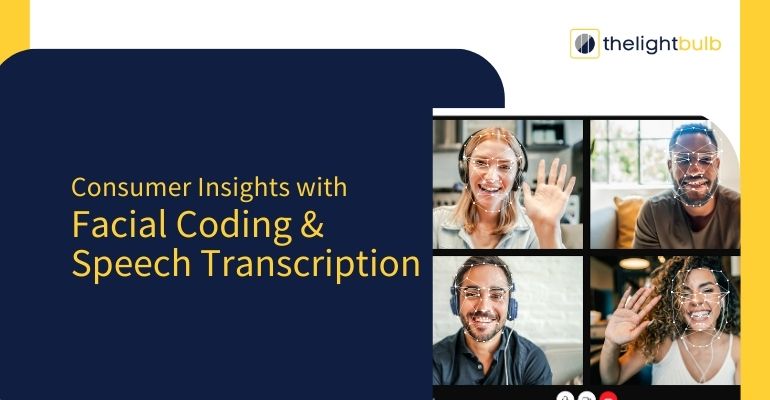
Facial expression AI fits into a concept test as an observation layer during exposure, before the questionnaire begins.
- Structure the concept so that each element appears in a known order or position: name, visual, benefit, proof point, price.
- Record with consent as participants view the concept on their own device.
- Capture visible response frame by frame; add eye tracking where possible to see which element was being read.
- Ask the standard questions straight afterwards: appeal, clarity, uniqueness, likelihood to buy.
- Collect open comments and analyse them with transcription or text sentiment tools.
- Align the evidence so each element has an observed response, an attention measure and a stated reaction.
Revealing elements in sequence, such as showing the price after the benefits, makes it easier to attribute changes in response to specific parts. The underlying analysis method is described in facial expression AI in product testing.
What can facial signals reveal about a concept?
Facial signals can reveal which elements of a concept coincided with changes in visible response, which helps teams decide what to keep, fix or drop.
Examples of useful patterns:
- The visual produces an early positive response, but the benefit line causes visible puzzlement. The benefit wording may need simplifying.
- Response stays flat until the price appears, then shows hesitation. The value story may need strengthening before the price.
- Two concepts score similarly in the survey, but one shows clearer visible interest at the core benefit. That concept may have a stronger idea at its heart.
- A novel concept shows surprise, then interest, while a familiar one shows little change. Novelty may be helping, though it needs confirming with comments.
Each is a hypothesis to check against comments and ratings, not a final verdict.
How should teams compare and refine concepts?
Teams should compare concepts element by element, using observed response, attention and stated feedback together.
| Element | Observed response | Attention | Stated feedback | Possible action |
| Product name | Little change | Read quickly | “Easy to remember” | Keep |
| Hero visual | Positive response | Strong early gaze | “Looks premium” | Keep |
| Main benefit | Visible puzzlement | Re-read several times | “Not sure what it means” | Rewrite and re-test |
| Price | Hesitation | Long fixation | “A bit expensive” | Test framing or pack size |
This table is illustrative of the method, not of any real study. The point is that each row tells the team where to act. Refined concepts can then be re-tested, and the strongest idea taken forward into creative evaluation with Emotion AI for its launch campaign.
Where does concept testing connect to the rest of the launch?
Concept testing connects to almost every launch decision that follows.
- Engagement with launch content can be tracked as described in how facial analysis measures engagement.
- Purchase-related responses can be explored in more depth, as in purchase-related emotional responses.
- The launch website or app can be checked for friction, using the approach in usability testing with facial coding.
Using the same research approach across stages makes results easier to compare.
What are the limits of facial expression AI in concept testing?
The key limit is that facial expression AI cannot determine whether a product will succeed after launch.
Several factors explain this:
- Concepts are not products. Reactions to an idea can differ from reactions to the real thing in use.
- Market factors are missing. Distribution, competition, pricing in store and advertising weight all shape results.
- Faces are not emotion meters. A 2019 scientific review led by Lisa Feldman Barrett concluded that facial movements do not reliably and specifically indicate particular emotions across people and contexts.
- Recording conditions vary. Webcam quality and lighting affect data.
Used carefully, facial analysis improves the diagnosis of a concept. It does not replace judgement about the business case.
How does TheLightbulb.ai support concept testing?
Concepts are one of the creative testing stimuli named on Insights Pro Quantitative, alongside ads, trailers, episodes and packaging or shelf designs. According to TheLightbulb.ai’s website, studies can combine facial coding, eye tracking, speech transcription, text sentiment and market surveys, with access to global online panels and an in-house customer insight research team.
For teams that prefer discussion-led concept work, Insights Pro Qualitative supports AI-assisted analysis of online focus groups and interviews.
Conclusion
Facial expression AI supports concept testing by showing how participants visibly responded to each element of an early idea, not just how they rated it overall. Paired with attention data and stated feedback, it points to the specific name, visual, benefit or price that is helping or hurting a concept.
That makes refinement faster and more targeted. It cannot guarantee launch success, but it can help ensure the concept that goes to market has been examined closely, element by element.
Frequently asked questions
Can facial expression AI tell if a product concept will succeed?
No. It shows how participants responded to the concept during testing. Launch success depends on the finished product, market conditions and execution.
At what stage should facial coding be added to concept testing?
As early as the first concept boards. Early insight lets teams refine wording, visuals and price framing before development costs rise.
Can facial expression AI compare several concepts at once?
Yes. Participants can view multiple concepts, in rotated order to reduce order effects, so responses can be compared element by element.
What concept elements are easiest to evaluate with facial coding?
Elements shown in a clear sequence or position, such as visuals, benefit lines and price reveals, are easiest to link to changes in visible response.
Does concept testing with Emotion AI replace purchase intent questions?
No. Purchase intent questions remain essential. Observed response adds context to help interpret those scores.