How Does Emotion AI Help Businesses Understand What Customers Really Feel?
Customers rarely describe their reactions in full. A shopper may say an advert was “fine” while looking away halfway through. A user may rate a checkout page as easy after hesitating over the payment step for a long moment. Businesses make expensive decisions on this incomplete picture every day.
Emotion AI for businesses addresses part of that gap. It gives researchers an additional, observable layer of evidence about how people respond in the moment. It does not read minds, and it does not replace asking people what they think. Used well, it helps teams ask better questions and interpret answers with more context.
Direct answer: Emotion AI helps businesses understand customer feelings by analysing observable signals, such as facial movements, gaze patterns, speech and written comments, while people interact with an advert, product, package or website. Researchers then interpret these signals alongside survey answers and behaviour to identify moments of interest, confusion or disengagement that stated feedback alone may not capture.
What is Emotion AI in market research?
Emotion AI in market research is the use of artificial intelligence to detect and measure observable signals linked to emotional response during a research task. The aim is to describe how participants reacted, moment by moment, to a defined stimulus.
Those signals usually come from several sources:
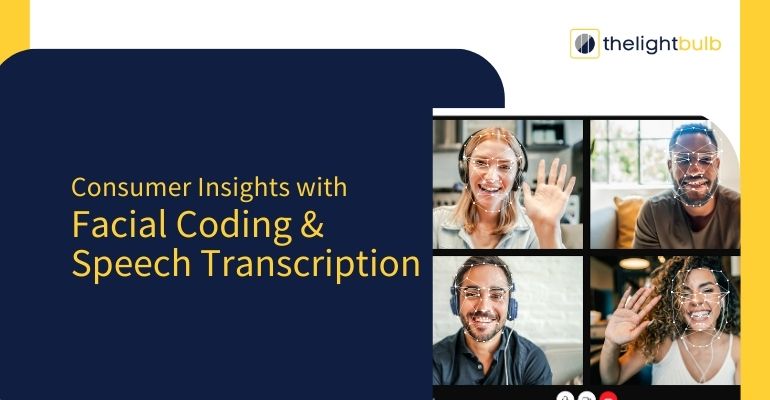
- Facial coding tracks visible facial muscle movements recorded on video.
- Eye tracking estimates where and for how long a participant looks.
- Speech transcription turns spoken comments into analysable text.
- Text sentiment analysis classifies the tone of written or transcribed responses.
- Market surveys capture what participants consciously state.
The important word is observable. Emotion AI measures what can be seen or heard, then uses models to infer emotional indicators. A raised lip corner is a measurable event. Calling it “enjoyment” is an inference that depends on context. This distinction runs through every well-designed study, and through the rest of this cluster.
How does Emotion AI work during a research study?
Emotion AI works by recording participants (with consent) as they complete a structured task, then analysing those recordings against the timeline of the stimulus.
A typical study follows five steps:
- Define the question. For example: “Which scene in our 30-second advert loses viewer attention?”
- Recruit and consent. Participants agree to webcam recording and understand how their data will be used.
- Expose the stimulus. Participants watch the advert, review a concept, browse a site or examine packaging.
- Capture signals. The software analyses facial activity and, where the setup supports it, gaze, alongside the survey or interview.
- Interpret in context. Researchers line up signal changes with specific moments, then compare them with what participants said.
Facial analysis in this field often builds on the Facial Action Coding System (FACS), developed by Paul Ekman and Wallace Friesen. FACS breaks facial activity into individual muscle movements called action units. It was designed to describe movement, not to label emotions. Automated systems detect these movements at scale, and researchers then interpret patterns of movement in light of the task. For a deeper look at this process with physical products, see how facial expression AI analyses reactions during product testing.
Why do businesses need more than stated feedback?
Businesses need more than stated feedback because people often cannot fully report their own reactions, and sometimes choose not to.
There are well-documented reasons for this. Respondents may give answers that sound socially acceptable. They may forget how they felt at second 12 of a 30-second advert. They may rationalise a choice after making it. None of this makes surveys wrong. It means a survey answer is one kind of evidence, collected after the moment has passed.
Emotion AI adds a second kind: a record of the moment itself. Comparing the two is where much of the value lies. If participants rate a concept highly but show little visible engagement while viewing it, that tension is worth exploring. We cover this in detail in Emotion AI vs traditional market research, and in the companion piece on reactions that surveys often miss.
Where do businesses use Emotion AI?
Businesses use Emotion AI wherever a decision depends on how people respond to something they see, hear or use. The most common applications in market research are:
- Advertising and creative evaluation. Teams test ads, trailers and episodes to see which moments hold attention and which lose it. See Emotion AI in advertising testing.
- Concept testing. Early ideas are shown to participants before money is committed to development. See concept testing before a product launch.
- Packaging and shelf design. Researchers study how people respond to colour, imagery and layout, and where their eyes go first. See consumer responses to product packaging.
- Website and app experience. UX teams look for moments of hesitation or confusion during tasks. See spotting user frustration in website and app testing.
- Engagement measurement. Content and media teams track attention and visible responsiveness across a piece of content. See how facial analysis measures engagement.
- Purchase-related research. Insights teams explore which product attributes generate visible interest during evaluation. See the emotional drivers of buying behaviour.
In each case, Emotion AI answers a narrower question than “what does the customer feel?” It answers “what did participants visibly respond to, and when?” That narrower question is far more useful, because it can be checked.
What does a realistic Emotion AI insight look like?
A realistic insight is specific, time-stamped and paired with other evidence. Consider a snack brand testing two pack designs.
Eye tracking shows participants find the brand name quickly on Design A but look at the flavour panel only briefly. On Design B, gaze moves to the flavour illustration first. Facial coding shows more visible positive activity during Design B exposure. In the survey, however, participants rate both designs similarly.
A careful researcher would not conclude “customers love Design B.” They would report that Design B drew earlier attention to flavour and produced more visible positive response during viewing, while stated preference was similar. The next step might be follow-up questions about flavour expectations. That is a decision-ready insight with its limits stated.
What are the limits of Emotion AI?
The main limit of Emotion AI is that facial movements are not a direct readout of inner feelings.
A major 2019 review led by Lisa Feldman Barrett examined the evidence and concluded that facial configurations are not reliable or specific enough, across people, contexts and cultures, to be treated as diagnostic of a particular emotional state. A smile can signal politeness or discomfort. A frown can signal concentration rather than dislike. Technology can detect movement; meaning depends on context.
For businesses, this leads to five practical rules:
- Treat facial signals as indicators, not verdicts.
- Interpret signals against the specific task and moment.
- Combine them with stated feedback and observed behaviour.
- Control recording conditions, such as lighting and camera angle, as far as possible.
- Never infer an individual’s purchase intent from facial activity alone.
Consent and data protection matter just as much. Participants should know they are being recorded, why, and how long their data will be kept.
How should businesses act on Emotion AI insights?
Businesses should use Emotion AI insights to sharpen decisions, not to make them automatically. The strongest use is diagnostic: finding where in an experience something changes, so the team knows what to investigate.
Practical actions include:
- Re-editing the scene in an advert where attention drops.
- Moving key information higher on a pack where gaze rarely lands.
- Simplifying a checkout step where many participants show visible hesitation.
- Probing a concept further when stated scores and observed response disagree.
Each action should be tested again. Emotion AI is most useful as part of a cycle of test, refine and retest.
How does TheLightbulb.ai apply Emotion AI to market research?
TheLightbulb.ai offers two Insights Pro products built around this research approach. According to its website, the platform combines facial coding, eye tracking, speech transcription, text sentiment, generative AI and market surveys.
- Insights Pro Quantitative supports quantitative studies with Emotion AI, global online panels and an in-house customer insight research team. Its use cases include creative testing (ads, concepts, trailers, episodes, and packaging or shelf designs), UI/UX testing for websites and web apps, and customer journey testing for online shopping.
- Insights Pro Qualitative applies AI-supported analysis to online focus groups and direct interviews.
The value for a research team is in bringing stated and observed responses into one study, so the comparison can be made directly.
Conclusion
Emotion AI for businesses is best understood as a way to see reactions that people do not always put into words. It records observable signals in the moment, links them to specific parts of an experience, and gives researchers another line of evidence to set against survey answers and behaviour.
It cannot tell a business exactly what a customer feels or why they buy. It can show where attention rose or fell, where visible responses changed, and where stated and observed reactions disagree. For teams testing ads, concepts, packaging or digital journeys, that combination leads to better questions and more confident decisions.
Frequently asked questions
What is Emotion AI in simple terms?
Emotion AI is technology that detects observable signals, such as facial movements, gaze and tone of language, and uses them to estimate emotional response. In market research, it shows how participants reacted at each moment of a test.
Can Emotion AI tell exactly what a customer feels?
No. Emotion AI detects observable signals and infers emotional indicators. Facial movements vary by person, culture and context, so researchers interpret them alongside what participants say and do.
Is Emotion AI a replacement for surveys?
No. Emotion AI complements surveys by adding in-the-moment evidence. Surveys capture what people consciously report; Emotion AI shows how they visibly responded. The two together give a fuller picture, as covered in how Emotion AI compares with surveys.
What technologies are used in Emotion AI research?
The main technologies are facial coding, eye tracking, speech transcription, text sentiment analysis and surveys. Some platforms also use generative AI to help summarise findings.
Do participants know they are being analysed?
Yes, in ethical research they must. Participants should give informed consent to video recording and analysis, and be told how their data is stored and used.