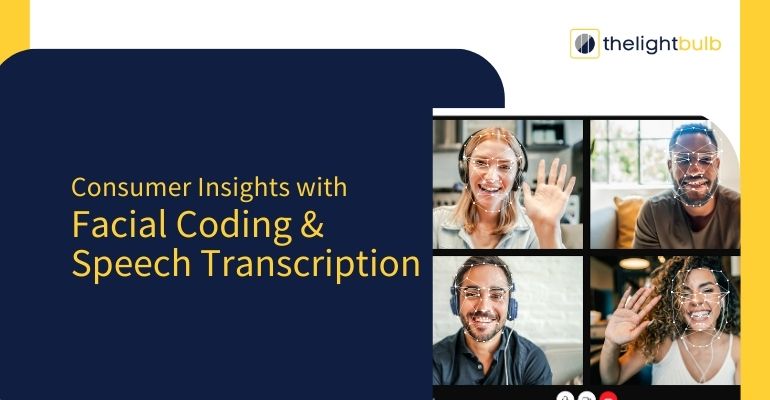
Can Facial Expression AI Reveal Customer Reactions That Surveys Often Miss?
A participant watches a new streaming trailer, then rates it 4 out of 5. Later, the team reviews the session video and sees something the score didn’t capture: during the second half, the participant’s visible responsiveness faded almost completely. Both data points are real. Only one made it into the report.
This is the gap behind the question of facial expression AI vs surveys. Surveys capture what people decide to say. Facial expression AI records how they visibly reacted while the experience was happening. For the foundations of this technology, see Emotion AI fundamentals.
Direct answer: Yes, facial expression AI can reveal reactions that surveys often miss, such as brief moments of confusion, fading attention or a visible response the participant never mentions. It does this by recording observable facial activity during exposure. It cannot reveal hidden feelings with certainty, so these observed signals are most useful when compared with what participants say.
What is the difference between stated and observed responses?
A stated response is what a participant reports; an observed response is what researchers can see or measure during the task.
The distinction matters because the two come from different moments and different processes:
| Response type | Example | When it is captured |
| Stated | “I found the trailer exciting” | After the experience |
| Observed (face) | Visible responsiveness falls in the second half | During the experience |
| Observed (gaze) | Eyes leave the screen for several seconds | During the experience |
| Observed (behaviour) | Participant skips ahead | During the experience |
Neither is “the truth”. A stated answer reflects a person’s considered judgement. An observed signal reflects a moment. Research becomes more useful when the two are read together, as the companion article on how Emotion AI compares with surveys explains.
Why do surveys miss some reactions?
Surveys miss some reactions because they rely on memory, self-awareness and willingness to share, and all three have limits.
Recall fades quickly. People summarise experiences rather than replay them. A short drop in interest at one scene rarely survives into an overall rating.
Social pressure shapes answers. Ivar Krumpal’s literature review on social desirability bias describes how survey respondents under-report what they see as undesirable and over-report what they see as desirable. In consumer research, this can show up as politeness toward a brand or a concept someone worked hard on.
Self-insight is limited. Classic psychology research by Nisbett and Wilson (1977) showed that people often give confident explanations for their behaviour that do not match what actually influenced them. Participants are not lying. They are explaining after the fact.
Question design narrows answers. A closed question can only capture what the researcher thought to ask.
These are reasons to supplement surveys, not to distrust them.
What reactions can facial expression AI pick up?
Facial expression AI can pick up visible changes in facial activity at specific moments, which point to reactions participants may not mention.
Useful examples include:
- Momentary confusion. Brow lowering during a dense claim or unfamiliar term.
- Fading responsiveness. A gradual flattening of facial activity during a long sequence.
- Brief positive responses. A quick smile at a joke or product reveal that is forgotten by the end.
- Mismatched politeness. A strong stated score alongside little visible response throughout.
The technology detects movement patterns; models then infer indicators. Most systems build on the Facial Action Coding System, which describes muscle movements without assigning meaning. See facial coding in product research for a step-by-step look at how this analysis runs.
Can facial expressions show what someone really feels?
No, facial expressions cannot show with certainty what someone really feels. This is the most important limit to understand.
A comprehensive 2019 review by Lisa Feldman Barrett and colleagues examined decades of research and found that people do not move their faces in consistent, specific ways for each emotion across contexts and cultures. Smiles occur in embarrassment and politeness. Scowls occur in concentration. One expression can mean several things, and one feeling can produce several expressions.
The honest claim, then, is narrower. Facial expression AI reveals observable responses that surveys do not record. It does not reveal hidden truths that surveys conceal. That narrower claim is still highly valuable, because it tells researchers where to look.
How should researchers use facial signals alongside surveys?
Researchers should use facial signals to locate moments of interest, then use surveys and follow-up questions to explain them.
A practical workflow:
- Run the survey and the facial analysis on the same participants and stimulus.
- Mark the moments where observed response changes sharply, up or down.
- Compare those moments with stated scores for the relevant element, such as a scene, claim or feature.
- Probe disagreements with targeted follow-up questions, for example: “What did you think when the price appeared?”
- Report both with clear labels: stated, observed and interpreted.
This approach applies across studies. In advertising, it explains why a liked ad may still underperform in places, a theme covered in Emotion AI in advertising testing. In UX research, it catches hesitation that participants dismiss as “nothing”, as discussed in spotting user frustration in website and app testing.
Where does this matter most for businesses?
It matters most where polite or summarised answers are likely and where timing within the experience matters.
- Concept and product tests, where participants may be kind to new ideas. See early-stage concept evaluation.
- Packaging and shelf research, where first impressions form in seconds. See testing packaging and shelf designs.
- Purchase research, where stated reasons for choosing may be rationalised. See emotional triggers behind purchase decisions.
- Content and media, where attention rises and falls minute by minute. See engagement signals in research.
What are the risks of over-reading facial data?
The main risk is treating an observed signal as a verdict. Common mistakes include:
- Labelling a participant as “lying” when their face and answer differ.
- Assuming low facial activity means low interest; some people are simply less expressive.
- Ignoring recording conditions, such as poor lighting or camera angle.
- Reporting individual results instead of group patterns.
Responsible use also means informed consent, clear data retention rules and transparent reporting of what the data can and cannot show.
How does TheLightbulb.ai help capture unstated responses?
TheLightbulb.ai positions its Insights Pro products around tapping into unstated responses alongside traditional survey questionnaires, according to its website. Its technology set includes facial coding and eye tracking for observed response, plus speech transcription, text sentiment and market surveys for stated response.
Insights Pro Quantitative supports this in creative, UI/UX and customer journey studies, with global online panels and an in-house research team. Insights Pro Qualitative supports analysis of focus groups and interviews, where observed and spoken responses can be reviewed together.
Conclusion
Facial expression AI can reveal customer reactions that surveys often miss: short-lived confusion, fading attention and brief responses that never make it into a rating. It does this by recording what is observable during the experience, not by reading minds.
The best research treats surveys and facial signals as two views of the same moment. Surveys explain; facial signals locate. Where they agree, confidence grows. Where they differ, the business has found a precise question worth asking.
Frequently asked questions
Do people lie in market research surveys?
No, not usually in a deliberate sense. More often, answers are shaped by memory, politeness and limited self-insight, which is why observed data adds useful context.
Can facial expression AI detect hidden emotions?
No. It detects visible facial activity and infers indicators. It can show responses participants did not mention, but it cannot confirm what they privately felt.
What is social desirability bias in surveys?
It is the tendency of respondents to give answers that seem socially acceptable, under-reporting undesirable views or behaviour and over-reporting desirable ones.
Should a business trust facial data over survey data when they disagree?
No. Neither should automatically win. A disagreement is a signal to investigate with follow-up questions or qualitative research.
Does facial expression analysis work in online surveys?
Yes, when participants consent to webcam recording and face the camera in reasonable lighting while viewing the stimulus.