Are People Seeing Your Brand in Your Ads? How Eye Tracking Measures Brand Visibility
Millions of dollars are poured into creative production and media placements annually, yet countless campaigns suffer from “brand blindness” where viewers notice the creative hook but completely miss the brand logo. In today’s crowded digital media landscape, capturing visual real estate is only half the battle. Advertisers often invest heavily in catchy storylines, vibrant colors, and star-studded talent, only to discover post-launch that audiences remember the entertainment value while retaining zero brand recall.
Traditional ad testing relies heavily on post-campaign surveys and focus groups that suffer from severe recall bias, social desirability effects, and post-rationalization. Respondents try to be helpful or logical, forgetting how they actually felt or what they initially looked at during the split-second moments of exposure. They cannot accurately recall whether the logo registered in their subconscious mind or if it was overshadowed by visual clutter.
This disconnect has driven a massive strategic shift toward brand visibility and logo salience measured through remote, webcam-based AI eye tracking. Anchoring into the comprehensive methodology of AI Eye Tracking: The Complete Guide to Measuring Visual Attention for Better Business Decisions, this guide explores how measuring visual fixations, saccades, and heatmaps guarantees your brand assets register in consumer consciousness all without physical labs or cumbersome hardware.
Operating as a remote-first Emotion AI SaaS platform, technology like TheLightbulb.ai empowers enterprises to capture unstated consumer responses at true online scale.
The Foundation: What Is AI Eye Tracking in Brand Visibility?
To understand how modern visual measurement works in evaluating brand visibility, we must first move beyond legacy hardware constraints. Traditional eye-tracking studies were restricted to expensive, 10-person physical labs using infrared table-mounted devices or bulky wearable glasses. These setups introduced artificial bias, restricted demographic diversity, and severely limited testing speed.
AI eye tracking replaces physical infrared hardware with advanced deep learning models and computer vision operating directly inside standard web browsers.
How Webcam-Based Tracking Works
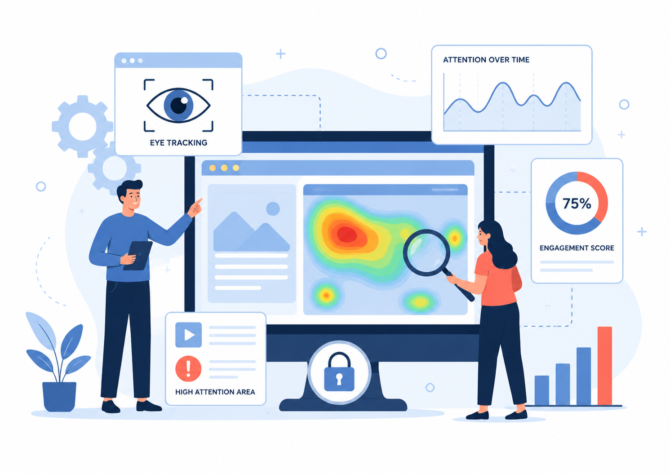
By mapping facial landmarks, estimating head pose in real time, and tracking gaze vectors securely and privately, modern algorithms calculate precisely where a user is looking on a digital screen. Because this process runs entirely through standard consumer webcams, brands can reach thousands of global respondents across natural home environments, mirroring real-world media consumption habits.
Global research leaders and enterprise brands such as Amazon, Myntra, Swiggy, Nielsen Media, Kantar, and NIQ leverage remote behavioral technologies to bypass lab bottlenecks, achieving rapid, statistically robust consumer insights before committing heavy media budgets.
Diagnosing Brand Blindness and Visual Clutter in Ad Creatives
The core challenge of creative effectiveness boils down to the first-second imperative. In digital spaces, consumers develop immediate mental filters to ignore irrelevant visual stimuli. If an ad fails to command immediate fixation on core brand assets within the opening seconds, subsequent messaging is wasted.
Fixations and Saccades on Brand Assets
When evaluating digital ad creatives, human visual processing relies on two primary optical mechanisms:
- Fixations: Measuring whether visual interest actually settles on logos, pack shots, and brand typography. If average fixation duration on a brand logo is near zero, the creative is suffering from severe brand blindness.
- Saccades: Analyzing smooth visual flow versus erratic jumps caused by cluttered design. A cluttered ad layout creates cognitive friction, causing the eye to bounce away from key brand identifiers rather than settling on them.
Visual Heatmaps and Emotion AI Synergy
By aggregating gaze data across user cohorts, platforms generate visual heatmaps that instantly highlight attention hot zones and blind spots. However, gaze alone only tells you where someone looked, not how they felt when they saw the logo.
Platforms bridge this gap by combining visual attention tracking with unstated, non-verbal emotional responses. By reading micro-expressions and facial muscle movements, Emotion AI decodes whether emotional valence and arousal spike when the brand logo appears on screen.
Expanding Brand Salience Across Digital Channels
Foundational gaze metrics serve as building blocks that connect advertising performance to brand salience, digital conversion paths, and multi-channel customer journeys.
A. Website Conversion & CTA Optimization
Transitioning ad traffic to landing pages often uncovers friction points such as Why Users Don’t Notice Your CTA: Using Eye Tracking to Improve Website Conversion. Ensuring brand continuity between the initial ad and the destination landing page is critical. Attention heatmaps diagnose UI/UX flows, helping conversion rate optimization (CRO) teams eliminate dead zones and ensure brand elements remain prominent alongside calls-to-action.
B. Video Ad Performance
Applying dynamic attention tracking for second-by-second drop-off analysis across video narrative arcs and logo supers is explored in detail through AI Eye Tracking for Video Ads: Measure What Viewers Actually Notice. This ensures that video creative holds viewer engagement and that brand supers appear during peak attention windows rather than during audience drop-off spikes.
C. Omnichannel Customer Journeys
Pinpointing attention fatigue across multi-touchpoint brand interactions is essential for long-term equity. As detailed in AI Eye Tracking for Customer Journey Research: Find Where Customers Lose Attention, consumers engage with brands across social feeds, search results, and mobile apps where consistent brand visibility drives cumulative recall.
Scaling Brand Insights Across B2B, Market Research, and Strategy
Consumer behavior extends far beyond a single ad placement, encompassing complex B2B ecosystems and macro market strategies.
A. B2B Buyer Journeys
Decoding complex brand information hierarchies in SaaS portals, whitepapers, and pricing pages requires specialized measurement. Eye Tracking for B2B Customer Journey Research: Understanding How Buyers Navigate Digital Experiences explores how enterprise buyers evaluate long-form brand content differently than retail shoppers, emphasizing the need for clear corporate branding within professional ecosystems.
B. Modernizing Market Research & Strategic Decisions
Traditional focus groups are increasingly vulnerable to facilitator and peer bias. AI Eye Tracking for Market Research: Understanding What Consumers Actually Do highlights how agencies like Nielsen Media, Kantar, and NIQ modernize traditional research with objective behavioral tracking. Furthermore, How AI Eye Tracking Can Help Businesses Make Better Marketing Decisions illustrates how executive leadership at companies like Amazon, Myntra, and Swiggy leverage brand visibility insights to make data-backed strategic decisions before heavy media spend.
Conclusion & Frequently Asked Questions (FAQs)
Optimizing brand visibility eliminates creative guesswork and protects media investments. By shifting from legacy hardware labs to scalable, webcam-based software, businesses can ensure their brand assets register in consumer consciousness with research-grade accuracy.
Ready to transform how your business measures visual attention and brand visibility? Explore how TheLightbulb.ai turns remote Emotion AI into your ultimate competitive advantage.
Frequently Asked Questions (FAQs)
1. What is AI eye tracking, and how does it measure brand visibility without special hardware?
AI eye tracking uses advanced computer vision and deep learning models running in standard web browsers. By analyzing facial landmarks, head orientation, and gaze vectors via a standard user webcam, the software maps visual fixations and heatmaps without requiring infrared equipment, glasses, or physical labs.
2. How do attention heatmaps diagnose brand blindness in digital ads?
Attention heatmaps aggregate gaze data across consumer cohorts to visually reveal whether viewers look directly at brand logos and product pack shots or if those elements fall into visual dead zones due to design clutter.
3. Can webcam-based tracking evaluate logo salience in video ads second-by-second?
Yes. Platforms like TheLightbulb.ai track dynamic attention curves across video timelines, isolating exact timestamps where viewer engagement peaks or drops during logo supers and brand reveals.
4. How do enterprise brands use brand visibility data to optimize marketing decisions before launch?
Global brands use remote Emotion AI platforms to pre-test ad creatives, packaging designs, and digital assets across thousands of respondents at online scale, replacing biased self-reported surveys with objective behavioral data prior to major budget allocations.