Eye Tracking AI for Video and Creative Testing: Understanding Viewer Attention Frame by Frame
Static creative is tested in a single glance. Video isn’t attention shifts constantly as a scene changes, a cut happens, or a new element enters the frame, which makes it a far harder format to evaluate through opinion-based feedback alone. Eye tracking AI addresses this directly, tracking viewer attention frame by frame through a video’s runtime and showing exactly when engagement builds, holds, or breaks insight that’s nearly impossible to reconstruct from a post-viewing survey.
Why Video Creative Is Harder to Test Than Static Assets
A print ad or a webpage can be evaluated as a single visual composition. A video unfolds over time, and viewer attention moves with it toward a face, a product, on-screen text, or away from the screen entirely if interest drops. Asking a viewer afterward “what did you notice” collapses that entire moving experience into a single, retrospective answer, losing the moment-to-moment detail of when attention was actually engaged.
This is precisely the problem eye tracking AI is built to solve for video: instead of one summary judgment, it produces a continuous record of where attention was, second by second, throughout the entire piece.
That continuous record matters because video engagement rarely fails or succeeds all at once. A piece of content can open strong, lose the audience midway through a slow transition, and never fully recover attention for the closing brand moment it was built around a pattern that a single post-viewing rating would flatten into an unhelpfully average score, hiding exactly where and why the disengagement happened.
This article is part of a broader series for the full picture of how eye tracking AI works across market research, see the complete guide to eye tracking AI in market research.
What Frame-by-Frame Attention Data Looks Like
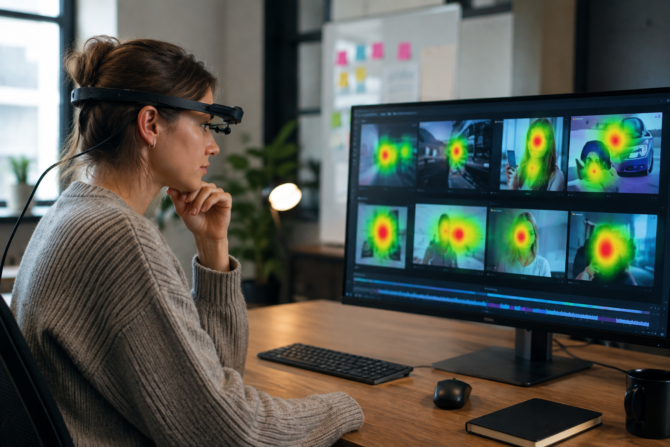
Applied to a video asset, eye tracking AI typically generates:
- Attention timelines — showing the percentage of viewers focused on key elements (product, talent, text, logo) at every point in the video
- Drop-off markers — the specific timestamps where viewer attention most commonly disengages
- Element-level fixation — confirming whether a product shot, CTA, or brand moment actually earns focus when it appears on screen
- Comparative cuts — attention data across two or more edits of the same video, useful for choosing the strongest version
This level of detail is particularly valuable for short-form and skippable video formats, where the first few seconds carry a disproportionate amount of weight in determining whether a viewer keeps watching at all. In these formats, creative teams are often optimising within a window of two or three seconds, and decisions made without frame-level attention data where to place the logo, when to introduce the product, how quickly to cut to the key message are effectively educated guesses rather than evidence-based choices.
Where Frame-by-Frame Testing Adds the Most Value
Trailer and episodic content testing — identifying exactly which moments hold attention and which cause viewers to disengage, informing both edit decisions and release strategy. This is a core part of trailer testing and episode testing workflows.
Skippable digital ads — pinpointing whether the opening seconds successfully hold attention before a viewer has the option to skip, which is often the single most important window in the entire asset.
Multi-version creative comparison — testing different cuts, orderings, or pacing of the same underlying footage to see, objectively, which version sustains attention longest.
Brand and product moment validation — confirming that key brand or product reveals actually land during a window when viewer attention is present, rather than during a drop-off period.
Adding Emotional Reaction to the Timeline
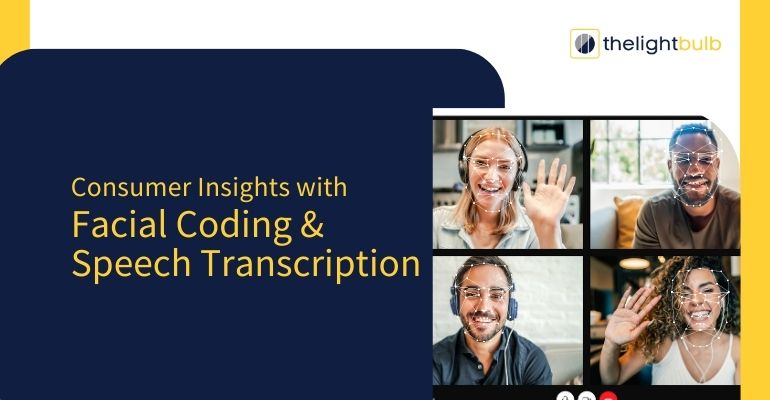
Attention alone shows that a viewer was looking at the screen not how they felt about what they saw. Layering emotion AI and facial coding onto the same video timeline shows whether a moment that holds attention also produces the intended emotional response: amusement during a comedic beat, tension during a dramatic one, interest during a product reveal. Together, gaze and emotion timelines give creative and editorial teams a frame-level view of both engagement and emotional impact, rather than one without the other.
What a Strong vs. Weak Attention Timeline Looks Like
Reading a frame-by-frame attention timeline comes down to recognizing a few consistent signatures.
A strong timeline typically shows attention arriving quickly in the opening seconds and holding at a high, steady level through the key narrative or product moments, with only a gradual, natural decline as the video approaches its natural end. Product or brand reveals land during a window when attention is still high, rather than after it has already started to fade.
A weak timeline often shows a sharp drop within the first few seconds a strong signal that the opening isn’t earning enough interest to keep viewers watching or a pattern where attention briefly spikes and then falls well before a key message or CTA appears. In some cases, the timeline reveals that a product reveal or brand moment lands during a section where attention has already substantially dropped off, meaning the moment the video was built around is barely being seen by the time it happens.
Comparing timelines across multiple cuts of the same content is often where this data becomes most actionable rather than judging a single edit in isolation, editorial teams can see directly which version of a scene order, pacing choice, or opening sequence sustains attention longer, and make a data-informed decision between them.
How a Frame-by-Frame Video Test Typically Runs
Running an eye tracking study on video content generally follows a consistent process:
- Video upload — the full video, or multiple cuts of it, is loaded into the testing platform at its intended runtime and format.
- Panel recruitment — a sample matched to the target audience is recruited to view the video under natural playback conditions.
- Webcam-based gaze capture — attention is recorded continuously throughout playback, without interrupting the viewing experience.
- Timeline aggregation — individual gaze data is combined across the sample into a second-by-second attention timeline for the full video.
- Reporting against creative objectives — timeline data is interpreted against specific questions, such as whether attention holds through a key product reveal or drops before it.
Because the entire process runs through a standard webcam, results are typically available fast enough to inform edit decisions before a final cut is locked.
Common Mistakes in Video Attention Testing
Testing only the finished, final edit. Frame-by-frame data is most valuable earlier in the editing process, when pacing, scene order, and timing can still be adjusted based on where attention holds or drops.
Focusing only on overall attention level, not where it’s directed. A video can hold attention throughout its runtime while that attention never actually lands on the product or brand moment total engagement and directed engagement are different findings, and both matter.
Ignoring the first few seconds. For skippable and short-form formats, the opening seconds often determine whether a viewer keeps watching at all testing should weight this window heavily rather than treating it the same as the rest of the video.
From Raw Attention Data to Editorial Decisions
The practical output of frame-by-frame testing isn’t just a chart it’s a set of specific, actionable editorial questions: Should this scene be trimmed because attention consistently drops during it? Should the product reveal move earlier, since attention peaks before it currently appears? Should an alternate cut be used instead, based on which version holds engagement longer? This turns creative testing from a subjective screening room discussion into a data-informed editing and release decision.
Conclusion
Video engagement isn’t a single, static judgment it’s built and lost moment by moment. Eye tracking AI captures that full timeline, showing creative and editorial teams exactly where attention holds and where it breaks, so decisions about cuts, pacing, and key moments are grounded in what viewers actually did, not what they remember afterward. For formats where every second of runtime is competing for a shrinking attention span, that level of detail is often what separates a video that performs from one that simply looks finished.
To test your next video or trailer before release, request a demo of TheLightbulb.ai’s Insights Pro, or read the complete guide to eye tracking AI in market research.