How Eye Tracking AI Reveals What Consumers Actually Notice Before They Buy
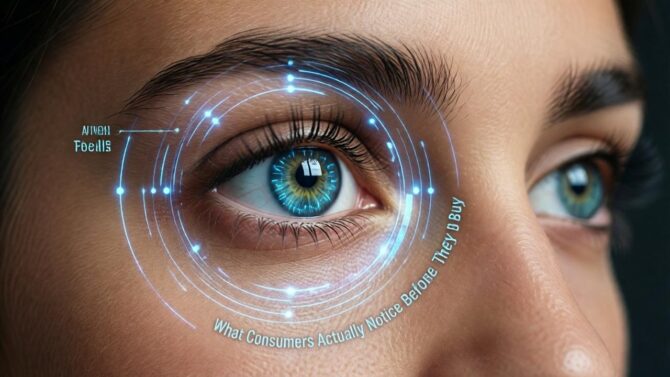
A purchase decision is rarely made in the moment someone reaches for a product. It’s shaped seconds earlier, in the brief window when their eyes move across a shelf, a screen, or an ad landing on some things, skipping others entirely. Eye tracking AI is the tool built to capture exactly that window, showing researchers not what shoppers say influenced them, but what genuinely entered their field of attention before the decision was made.
This distinction matters more than it might seem. Traditional research methods surveys, interviews, focus groups rely on people accurately remembering and reporting their own behavior. But visual attention happens too fast, and too automatically, for most people to consciously track or recall. Eye tracking AI removes that reliance on memory altogether.
For brand, insights, and packaging teams, this isn’t a small methodological footnote it’s often the difference between a design that tests well internally and one that actually performs at the point of purchase. When a brand’s understanding of “what consumers notice” is based entirely on self-reported feedback, it’s effectively working from an approximation of behavior rather than the behavior itself, and that gap tends to widen precisely in the moments that matter most: the first few seconds of exposure to a shelf, an ad, or a product page. This article is part of a broader series for the full picture of how eye tracking AI works across market research, see the complete guide to eye tracking AI in market research.
Why Self-Reported Attention Isn’t Reliable
Ask a shopper what they noticed first on a product label, and they’ll usually give you a confident answer. The problem is that confident answers aren’t always accurate ones. Attention is largely a pre-conscious process the eyes move toward color contrast, faces, motion, and familiar shapes before the brain has consciously “decided” to look at anything.
This creates a well-documented gap between stated and actual behavior. Shoppers might report noticing the brand name first, when eye tracking data shows their gaze actually landed on the price tag or a competitor’s product beside it. They might overlook a claim entirely and still mention it in a survey, simply because it’s a phrase they associate with the category. Eye tracking AI doesn’t ask people to reconstruct what happened it records it directly, as it happens.
What Eye Tracking AI Actually Measures
At a technical level, eye tracking AI uses computer vision often through a standard webcam rather than dedicated hardware to follow the position and movement of a person’s gaze in real time. From that raw gaze data, researchers can generate several distinct outputs:
- Attention heatmaps — visual overlays showing exactly where gaze concentrated most, and for how long
- Gaze sequence / scan paths — the order in which different elements were viewed
- Time to first fixation — how quickly an element (a logo, a claim, a price) was noticed
- Total dwell time — how long attention stayed on a given area before moving on
- Areas of no interest — elements that were present but never actually looked at
Together, these metrics reconstruct the full visual journey a shopper takes not a single snapshot, but a sequence, which is often more revealing than any one data point alone.
What This Looks Like Before a Purchase Decision
Applied to a real shopping scenario a product on an e-commerce page, a shelf display, or an ad eye tracking AI typically surfaces a consistent pattern: attention is won or lost within the first few seconds, and it’s rarely distributed evenly across a design. A hero image or bold claim might absorb the majority of gaze time, while supporting text, secondary CTAs, or fine print get skipped almost entirely, regardless of how important they are to the brand’s message.
This is where eye tracking AI becomes directly actionable for market research. If a brand assumes shoppers are reading a key product benefit but the data shows near-zero fixation on that section, that’s a design and messaging problem eye tracking makes visible one that a satisfaction survey would likely never surface, because the respondent never consciously registered the miss in the first place.
Combining Attention Data With Other Signals
Attention alone tells you where someone looked not why, or how they felt about what they saw. That’s why eye tracking AI is most powerful when it’s layered with complementary signals: facial coding and emotion AI to understand the emotional reaction tied to a fixation point, and text or verbal sentiment analysis to connect attention with what a respondent later says about the experience.
This combined approach visual behavior plus emotional and verbal response gives research teams a far more complete, evidence-based read on the pre-purchase moment than any single method used in isolation. It’s the foundation of platforms like Insights Pro Quantitative, which pair eye tracking with these other Emotion AI signals inside a single research workflow.
How Research Teams Use This in Practice
In applied market research, pre-purchase attention data is typically used to answer specific, practical questions:
- Does the primary product benefit get noticed at all, or is it visually buried?
- Is the brand logo seen quickly enough to build recognition, or lost among competing elements?
- Which pack design, out of several options, wins attention fastest in a shelf-comparison test?
- Do shoppers’ eyes move toward price before or after they engage with the product image?
These questions map directly onto packaging design, creative testing, and shelf/e-commerce layout decisions all areas where understanding actual visual behavior, not just stated opinion, materially changes the outcome of a research study.
A Step-by-Step Look at How a Pre-Purchase Attention Study Runs
Understanding the process behind the data helps explain why it’s trusted more than self-reported recall. A typical pre-purchase eye tracking study follows a consistent sequence:
- Stimulus preparation — the product, pack, ad, or shelf scene respondents will view is set up exactly as it would appear in the real purchase environment.
- Panel recruitment — a relevant sample of shoppers, matched to the brand’s actual target audience, is recruited through an online research panel.
- Webcam-based gaze capture — respondents view the stimulus for a natural, unscripted amount of time while gaze coordinates are recorded in the background.
- Data aggregation — individual gaze paths are combined across the full sample to build heatmaps and attention metrics that represent group-level behavior, not one person’s viewing.
- Reporting against the research question — the aggregated data is interpreted against the specific business question, such as whether a redesigned claim earns more attention than the previous version.
Because this process runs through a standard webcam rather than dedicated lab hardware, it can be deployed across large, geographically distributed samples in days rather than the weeks a traditional in-person eye tracking study would require.
Common Misconceptions About Pre-Purchase Attention Data
A few misunderstandings tend to come up when teams first start using eye tracking AI for pre-purchase research, and it’s worth addressing them directly.
“More attention always means a better outcome.” Not necessarily. A shopper’s gaze can linger on a confusing price display out of hesitation, not interest. Attention data needs to be interpreted alongside emotional or behavioral context, not read as a positive signal by default.
“One respondent’s gaze path is representative.” Individual variation is normal and expected; the value of the method comes from aggregating attention across a meaningful sample size, where consistent patterns are far more reliable than any single viewing.
“Eye tracking replaces the need to ask shoppers anything.” It replaces the need to rely on memory for what was seen, but stated preference, purchase intent, and reasoning still add context eye tracking alone can’t provide the two methods work best together, not as substitutes for one another.
Conclusion
Understanding what consumers actually notice before they buy is one of the clearest, most practical applications of eye tracking AI in market research. It replaces guesswork and self-reported recall with a direct, evidence-based record of visual attention and becomes even more powerful when paired with emotion AI and sentiment data. For brand, packaging, and creative teams, this shift from assumption to observed behavior is often the difference between a design decision that looks good internally and one that actually performs at the point of purchase.
To see how this works on your own creative, packaging, or shopping experience, request a demo of TheLightbulb.ai’s Insights Pro, or read our complete guide to eye tracking AI in market research for the full picture.
Frequently Asked Questions
Does eye tracking AI need special hardware?
Not necessarily. Modern eye tracking AI can run through a standard webcam, which is what makes it practical to deploy across large, distributed research panels rather than only in a physical lab.
Is eye tracking AI more accurate than asking people what they noticed?
It measures something different and more reliable for this purpose actual visual behavior rather than a person’s memory or interpretation of their own behavior, which is often incomplete.
Can eye tracking AI be used on both physical and digital shopping environments?
Yes. It’s applied to shelf and packaging tests, e-commerce pages, print and digital ads, and in-store simulations, wherever visual attention plays a role in the decision.
Should eye tracking AI replace surveys entirely?
No it’s best used alongside surveys and other methods. Eye tracking shows what people looked at; surveys and interviews can still add context on preference, intent, and stated reasoning.
How large does a research panel need to be for reliable pre-purchase attention data?
It depends on the research design and how confident the team needs to be in the finding, but as with most quantitative research, a sample large enough to smooth out individual variation is needed before a pattern can be treated as reliable.
Can pre-purchase eye tracking studies be run quickly, or do they take weeks to set up?
Because webcam-based eye tracking AI doesn’t require in-person lab sessions, studies can typically be fielded and reported on in a matter of days, which is considerably faster than traditional hardware-based eye tracking research.