
Who Can Benefit from AI for Market Research? 8 Teams That Gain the Most (2026)
Market research agencies, enterprise brands, marketers, media teams, product and UX teams, e-commerce businesses, small businesses and academic researchers can all benefit from AI for market research. Each gains faster analysis, emotional insight and lower research costs, but in different ways.
Whether you are a research professional, a business owner or a marketer, the challenge is the same. Datasets are getting more complex and customer behaviour keeps changing, so traditional methods alone can’t keep up. If you’re new to the concept, start with what AI for market research is. This guide explains who gains the most from AI for market research and why.
Who Can Benefit from AI for Market Research? (Quick Answer)
Any team that needs fast, reliable and emotion-rich consumer insight can benefit from AI for market research, from large agencies to solo researchers.
| Who | Main Research Challenge | How AI Helps | Best-Fit Technology |
| Research agencies | Tight turnaround, manual coding | Automates analysis and reporting | Transcription, generative AI |
| Enterprise and FMCG brands | Survey answers don’t match behaviour | Captures unstated responses | Facial coding, eye tracking |
| Marketers and ad teams | Unclear creative performance | Measures emotion second by second | Facial coding |
| Media and content creators | Testing audience engagement | Tracks engagement and distraction | Facial coding |
| Product and UX teams | Finding user friction | Maps attention and confusion | Eye tracking |
| E-commerce businesses | Journey drop-offs | Maps emotion at each step | Emotion AI, sentiment analysis |
| Small businesses and startups | Limited budgets | Runs studies online at low cost | Webcam-based SaaS |
| Academic researchers | Limited resources, slow analysis | Automates large-scale analysis | NLP, auto-coding |
8 Teams That Benefit Most from AI Market Research
1. Market Research Agencies
AI helps agencies deliver deeper insights to clients in less time.
Agencies juggle multiple projects with tight deadlines, and manual transcription and coding eat into margins. AI automates transcription, theme coding and report creation, so researchers can focus on strategy and storytelling. Agencies can also add facial coding and eye tracking to their studies, giving clients emotional data that competitors may not offer. Running both research types on one platform shows how AI improves qualitative and quantitative market research within a single project.
2. Enterprise and FMCG Brands
AI helps brands see the gap between what consumers say and what they actually feel.
Consumers often give polite survey answers that don’t match their buying behaviour. Facial coding and eye tracking capture unstated reactions to product concepts, packaging and advertising. When those reactions are compared with stated answers, brands can separate honest feedback from biased responses. This helps brands understand consumer behaviour with AI instead of relying on stated opinions alone.
3. Marketers and Advertising Teams
AI shows marketers which creative works before the media budget is spent.
Emotion AI tracks second-by-second reactions to video ads, banners and social creatives, while eye tracking shows whether viewers notice the brand, product or call-to-action. Marketers can then refine weak scenes and choose the strongest version before launch. Creative testing is one of the clearest examples of how AI is used in market research.
4. Media, Broadcasters and Content Creators
AI helps media teams measure real audience engagement with their content.
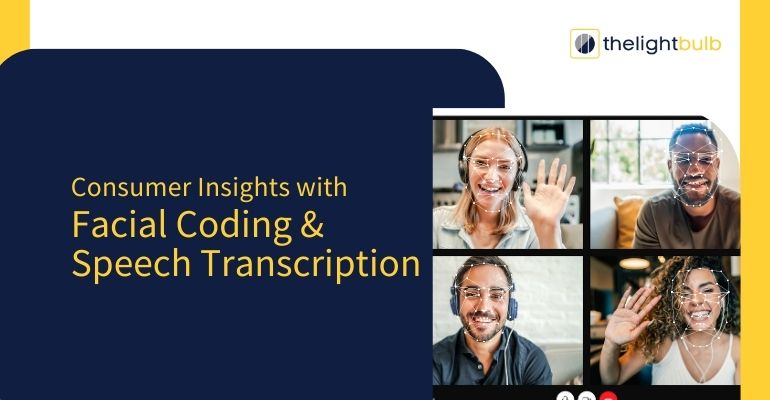
Broadcasters test TV promos and long-format ads, while online learning businesses need to know when viewers lose interest. Facial coding tracks engagement and distraction cues similar to those people show in face-to-face interactions. That builds a feedback loop for content creators, who can keep improving scripts, pacing and visuals based on actual reactions rather than guesswork.
5. Product and UX Teams
AI shows product teams exactly where users look, hesitate and get confused.
Eye tracking produces heatmaps, gaze plots and Areas of Interest (AOIs) for websites, apps and interfaces. Paired with facial coding, it reveals both where users look and how they feel at that moment, such as frustration on a checkout form. UI/UX testing is one of many types of market research AI can support.
6. E-Commerce and Digital Businesses
AI helps e-commerce teams find the exact moments where buyers hesitate or drop off.
Digital businesses often know that customers leave, but not why. AI maps emotions across each step of the customer journey and analyses review sentiment at scale. Together, these reveal friction points in navigation, pricing pages or checkout. They are clear examples of what AI market research helps businesses discover: specific, fixable problems rather than vague assumptions.
7. Small Businesses and Startups
AI gives small businesses access to research methods that were once affordable only for large brands.
Traditional emotion research needed physical labs, special equipment and large budgets. Today, webcam-based facial coding and eye tracking run online, and SaaS platforms scale to project size. A startup can test an ad, landing page or packaging idea with real consumers in days. This is a practical example of how AI helps in market research for lean teams.
8. Academic and Independent Researchers
AI levels the playing field for researchers with limited resources.
AI gives researchers from all backgrounds access to advanced tools, which supports meaningful, independent research. NLP, automated coding and pattern detection make large qualitative datasets manageable without big teams. Understanding how AI analyzes market research data helps researchers design studies that make full use of these capabilities.
Is Your Team Ready for AI Market Research?
Your team is ready for AI market research if it runs research regularly, handles large or unstructured data, or needs deeper emotional insight.
Ask these five questions:
- Do you run surveys, interviews or focus groups regularly?
- Do you test ads, creatives or user experiences?
- Does slow analysis delay important decisions?
- Do survey results sometimes conflict with real sales data?
- Do you lack dedicated in-house analysts?
If you answered yes to two or more, the benefits of using AI for market research will likely outweigh the setup effort.
What Should Each Team Watch Out For?
AI works best with human oversight, and each team faces slightly different challenges.
- Agencies: Avoid over-automation. Researchers should still interpret and validate results.
- Brands: Close gaps between quant and qual teams by working on one shared platform.
- All teams: Protect privacy with consent-based tools that follow data protection standards.
- Small businesses: Make up for limited in-house expertise by choosing vendors that provide research support.
How TheLightbulb.ai Supports Every Research Team
Insights Pro, TheLightbulb.ai’s Emotion AI research platform, helps enterprise brands and market research agencies run quantitative and qualitative projects with faster turnaround, lower cost and deeper insights.
Insights Pro combines facial coding, eye tracking, speech transcription and text sentiment analysis. Its generative AI tools reduce data analysis time by up to 60%. Teams also get access to global online panels and an in-house consumer insights research team.
TheLightbulb.ai was named MarTech Startup of the Year 2024 at the BrandWagon MarTech Summit and was a finalist for the YES Awards at ESOMAR Singapore 2024. Explore AI-powered market research, or book a free 30-minute live demo.
FAQs
Who uses AI for market research?
Market research agencies, enterprise brands, marketers, media companies, product and UX teams, e-commerce businesses, startups and academic researchers all use AI for market research. Any team that needs fast, emotion-rich consumer insight can benefit.
Is AI market research useful for small businesses?
Yes. Webcam-based AI tools run online without expensive research labs. Small businesses can test ads, websites and products with real consumers quickly and at a fraction of traditional research costs.
How do market research agencies use AI?
Agencies use AI to automate transcription, coding and reporting, and to add facial coding and eye tracking to client studies. This shortens project timelines and gives clients deeper emotional insights.
Can UX designers use AI market research tools?
Yes. UX designers use AI eye tracking and facial coding to see where users look, hesitate or feel frustrated. These insights help improve layouts, navigation and checkout flows.
Do you need technical skills to use AI market research?
No. Most AI market research platforms offer ready-made dashboards and automated reports. Researchers set up studies and interpret results, while the platform handles the technical analysis.
Is AI market research worth it for startups?
Yes, for most startups. AI market research helps startups validate ideas, ads and products with real consumer reactions before spending heavily on launch, which reduces the risk of costly mistakes.
Conclusion
So, who can benefit from AI for market research? Agencies, brands, marketers, media teams, UX teams, e-commerce businesses, startups and researchers all can. Each gains faster analysis, emotional depth and more confident decisions. To explore how the technology works across every use case, read our complete guide to AI in market research or book a live demo of Insights Pro.