
How Is AI Used in Market Research? 8 Practical Use Cases (2026)
AI is used in market research to test ads and creatives, study website and app usability, map customer journeys, evaluate packaging and concepts, enhance surveys with emotion data, analyse focus groups and interviews, track review sentiment and automate reporting.
Market research is moving from slow, manual methods to AI-led workflows that capture both what people say and how they react. If you’re new to the concept, start with what AI for market research is. This guide focuses on the practical side of AI for market research: the real use cases, what AI measures in each one, and how a typical study runs.
How Is AI Used in Market Research? (Quick Answer)
AI is used wherever researchers need to measure consumer reactions, analyse large datasets or speed up reporting.
| Use Case | What AI Measures | Technology | Typical Output |
| Ad and creative testing | Emotion and attention per second | Facial coding, eye tracking | Emotion curves, heatmaps |
| Website, app and UX testing | Gaze, hesitation, frustration | Eye tracking, facial coding | Heatmaps, AOI reports |
| Customer journey testing | Emotion at each step | Emotion AI | Journey emotion map |
| Packaging and concept testing | First-glance attention, appeal | Eye tracking, facial coding | Shelf heatmaps, concept scores |
| Survey enhancement | Stated plus unstated responses | Facial coding + surveys | Bias-checked results |
| Focus groups and interviews | Speech, tone, expressions | Transcription, facial coding | Coded themes, highlights |
| Review and social analysis | Sentiment, themes, opinions | NLP | Sentiment dashboards |
| Insight reporting | Key findings | Generative AI | Audience-ready reports |
8 Ways AI Is Used in Market Research
1. Ad and Creative Testing
AI measures how viewers feel and where they look while watching an ad, second by second.
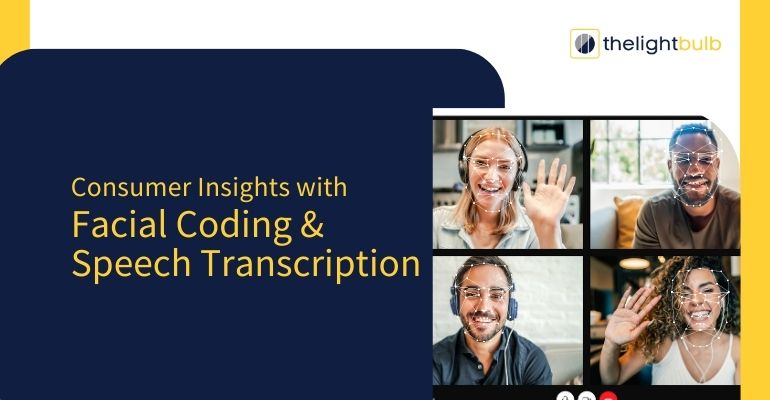
Facial coding reads facial muscle movements, called action units, using the Facial Action Coding System (FACS) developed by psychologist Paul Ekman. It turns these into an emotion curve for the whole ad. Eye tracking shows whether viewers notice the brand, product and call-to-action. Brands use this to test video ads, TV promos, long-format content and social creatives before launch. Marketers and agencies rely on it most, which is why they rank high among who can benefit from AI for market research.
2. Website, App and UX Testing
AI shows where users look, hesitate and get frustrated on a website or app.
Eye tracking produces heatmaps, gaze plots and Areas of Interest (AOIs) that reveal which elements attract attention and which get ignored. Eye tracking alone shows where people look but not how they perceive what they see, so facial coding is added to capture emotions such as confusion on a pricing page or frustration at checkout. Product teams then fix the exact screens that cause friction.
3. Customer Journey Testing
AI maps a customer’s emotions at every step of the buying journey.
Participants move through a real journey, from landing page to product page to checkout, while AI records their reactions through a standard webcam. What once required a physical lab now runs online with participants in their own homes. The result is an emotion map that shows where excitement rises and where doubt appears. This is one of the clearest ways to understand consumer behaviour with AI.
4. Packaging and Concept Testing
AI tests how shoppers notice and react to new packaging or product ideas before launch.
Eye tracking shows whether a pack design stands out and which details shoppers see first. Facial coding measures emotional appeal, showing whether a concept creates interest, surprise or indifference. Brands can compare several designs and choose the strongest one with confidence. Packaging and concept research is one of the many types of market research AI can support.
5. Survey Enhancement with Emotion Data
AI adds an emotional layer to standard surveys by capturing reactions alongside answers.
When respondents answer questionnaires, facial coding and eye tracking run in the background with their consent. Researchers can then compare stated answers with unstated reactions. If someone rates an ad highly but shows little emotional engagement, that gap becomes a valuable signal. This helps teams separate honest feedback from polite or biased responses.
6. Online Focus Groups and In-Depth Interviews
AI transcribes, codes and analyses live and recorded qualitative sessions.
Voice recognition converts discussions into text, while facial coding captures participants’ reactions during key moments. AI then automates coding and categorisation, detects conversational patterns and flags complex cases or outliers. Researchers get faster turnaround with less manual effort, which is a key reason AI improves qualitative and quantitative market research equally.
7. Review, Social Media and Open-Ended Text Analysis
AI reads thousands of reviews, posts and open-ended answers to extract sentiment and themes.
NLP models recognise sentiment, identify recurring themes and uncover customer opinions and biases in unstructured text. For example, AI can detect growing complaints about packaging or the product features customers mention most often. See how AI analyzes market research data for the full step-by-step process.
8. Automated Insight Reporting
Generative AI summarises findings and creates reports for different audiences.
Instead of spending days building presentations, researchers get automated summaries, visualisations and narrative reports tailored for executives, marketers and product teams. TheLightbulb.ai’s generative AI tools can reduce data analysis time by up to 60%. Faster reporting turns raw data into the insights AI market research helps businesses discover while those insights are still actionable.
How Does an AI Market Research Study Work?
A typical AI market research study follows six steps, from choosing the technology to combining insights with survey data.
- Choose the tech mix: Decide whether the study needs facial coding, eye tracking, voice analysis or a combination.
- Select participant panels: Recruit a diverse, representative audience.
- Design the study: Build a clear, engaging methodology for participants.
- Execute and collect data: Run the study on a reliable Emotion AI platform.
- Analyse the results: Review emotional peaks, dips and attention metrics on dashboards.
- Integrate insights: Combine AI data with survey results and business data.
This structured workflow shows how AI helps in market research deliver faster, more reliable results.
Traditional vs AI-Powered Research Methods
| Research Activity | Traditional Approach | AI-Powered Approach |
| Ad testing | Post-view surveys | Second-by-second emotion and attention data |
| UX testing | Observation and notes | Heatmaps, gaze plots and emotion tracking |
| Focus groups | Manual transcription and coding | Auto-transcription and theme coding |
| Review analysis | Manual sampling | Sentiment analysis at full scale |
| Reporting | Days to weeks | Automated, audience-ready reports |
These shifts add up to the core benefits of using AI for market research: speed, depth and less manual effort.
Best Practices When Using AI in Market Research
Use AI to support research teams, not to replace their judgement.
- Keep humans in the loop: Avoid over-automation. Researchers should validate and interpret results.
- Connect quant and qual teams: Use one shared platform so insights don’t stay siloed.
- Collect data with consent: Choose tools that follow data protection standards.
- Get vendor support: If in-house expertise is limited, work with platforms that offer research guidance.
How TheLightbulb.ai Brings These Use Cases Together
Insights Pro, TheLightbulb.ai’s Emotion AI research platform, combines facial coding, eye tracking, speech transcription, voice tone and text sentiment analysis with generative AI to power every use case above.
With Insights Pro, teams can run creative testing, user journey testing and UI/UX testing, as well as qualitative interviews and focus groups, all on one platform. It automates repetitive tasks and delivers reports tailored to each stakeholder.
TheLightbulb.ai was named MarTech Startup of the Year 2024 at the BrandWagon MarTech Summit and was a finalist for the YES Awards at ESOMAR Singapore 2024. Explore AI-powered market research, or book a free 30-minute live demo.
FAQs
How do companies use AI for market research?
Companies use AI to test ads, websites, packaging and customer journeys, analyse focus groups and reviews, and automate reporting. AI captures both what consumers say and how they react emotionally.
Can AI be used for ad testing?
Yes. AI uses facial coding to measure viewers’ emotions second by second and eye tracking to show what they notice. Brands use these insights to improve ads before launch.
How is AI used in focus groups?
AI transcribes focus group discussions, codes responses automatically and uses facial coding to capture participant reactions. This speeds up analysis and reveals patterns researchers might miss.
How is AI used in surveys?
AI enhances surveys by running facial coding and eye tracking while respondents answer questions. Researchers can compare stated answers with emotional reactions to spot biased responses.
What is the most common use of AI in market research?
Ad and creative testing is among the most common uses. Along with sentiment analysis of reviews and social media, it is widely used because it delivers fast, clear insights.
Do you need special equipment to use AI in market research?
No. Modern AI market research platforms work with a standard webcam or mobile camera. Participants can take part online from home, without physical labs or special hardware.
Conclusion
So, how is AI used in market research? It powers ad testing, UX research, journey mapping, packaging studies, survey enhancement, focus group analysis, sentiment tracking and automated reporting. AI gives research teams faster, deeper and more reliable insights at every stage. To explore the technology in full, read our complete guide to AI in market research or book a live demo of Insights Pro.