
How Does AI Analyze Market Research Data? A Step-by-Step Guide (2026)
AI analyzes market research data in six steps. It collects the data, transcribes and cleans it, analyses language with natural language processing (NLP), measures emotion and attention through facial coding and eye tracking, detects patterns with machine learning, and turns the results into reports with generative AI.
Research teams today handle survey responses, recorded interviews, webcam videos, reviews and social posts, often all in one project. Analysing them by hand takes weeks. If you’re new to the concept, start with what AI for market research is. This guide explains the analysis process behind AI for market research, step by step.
How Does AI Analyze Market Research Data? (Quick Answer)
AI analyzes market research data by turning raw text, voice, video and survey responses into structured insights through six connected steps.
| Step | What Happens | AI Technology | Output |
| 1. Collect | Data gathered from all sources | Research platform | Unified dataset |
| 2. Prepare | Audio transcribed, data cleaned | Voice recognition | Clean, readable data |
| 3. Analyze language | Sentiment and themes extracted | NLP | Theme and sentiment maps |
| 4. Measure emotion | Reactions and attention tracked | Facial coding, eye tracking | Emotion curves, heatmaps |
| 5. Detect patterns | Trends and outliers identified | Machine learning | Key patterns, flagged cases |
| 6. Report | Findings summarised | Generative AI | Audience-ready reports |
What Types of Data Can AI Analyze in Market Research?
AI can analyze text, voice, video, eye movement and numeric survey data, often within the same study.
| Data Type | Common Sources | AI Technique |
| Text | Reviews, social posts, open-ended answers | NLP, sentiment analysis |
| Voice | Interviews, focus groups | Voice recognition, tone analysis |
| Video | Webcam reactions during tests | Facial coding |
| Gaze | Ads, websites, packaging | Eye tracking |
| Survey scores | Questionnaires, ratings | Machine learning, statistical models |
Because AI handles so many formats together, it fits almost every type of market research, from ad testing to brand tracking.
How AI Analyzes Market Research Data: 6 Steps
Step 1: Collect and Combine Data
AI begins by bringing all research data into one platform.
Survey responses, webcam recordings, interview audio, customer reviews and social posts are gathered into a single, unified dataset. Participants join online through a standard webcam or mobile camera, with their consent, from representative research panels. Combining data early lets AI connect what people say with how they react. These are the same data sources behind most ways AI is used in market research, including ad testing, UX research and focus groups.
Step 2: Transcribe and Prepare the Data
AI converts audio into text and cleans the dataset so it can be analyzed accurately.
Voice recognition automatically transcribes recorded interviews and focus groups, including speaker changes and key conversational moments. AI then removes noise, duplicates and irrelevant entries, and it standardises formats across sources. Without this step, the insights produced later would be less reliable. Researchers no longer spend hours taking notes or typing transcripts.
Step 3: Analyze Language with NLP
NLP reads text to identify sentiment, intent, keywords and recurring themes.
AI deciphers the structure of text, recognises positive, negative and neutral sentiment, and maps intent for each line a customer writes or speaks. It then extracts key themes and groups related comments automatically, replacing manual coding. For example, NLP can detect rising concerns about packaging or identify the product attributes customers praise most, without anyone tagging responses by hand.
Step 4: Measure Emotion and Attention
Facial coding and eye tracking measure the unstated reactions that words alone cannot capture.
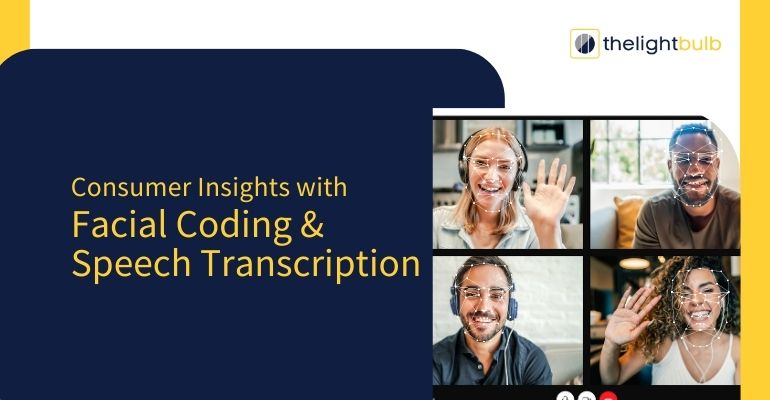
Facial coding reads facial muscle movements, called action units, using the Facial Action Coding System (FACS) developed by psychologist Paul Ekman. Each action unit links to a specific emotion, creating a second-by-second emotion curve. Eye tracking adds heatmaps, gaze plots and Areas of Interest (AOIs) that show where attention goes. Together, they build emotional heatmaps of participants, the data that helps businesses understand consumer behaviour with AI.
Step 5: Detect Patterns, Outliers and Trends
Machine learning finds hidden patterns, unusual cases and emerging trends across the dataset.
AI compares thousands of responses at once to surface patterns humans might miss, such as a specific ad scene that triggers negative emotion across one age group. It also flags outliers and complex cases for deeper review. By comparing stated answers with emotional reactions, AI helps researchers spot biased or polite responses. This step reveals much of what AI market research helps businesses discover.
Step 6: Generate Insights and Reports
Generative AI summarises findings and creates reports tailored to each audience.
Instead of building presentations manually, researchers receive automated summaries, visualisations and narrative insights. Reports can be customised for executives, marketers and product teams, each with the level of detail they need. TheLightbulb.ai’s generative AI tools can reduce time spent on data analysis by up to 60%.
How AI Analysis Differs for Qualitative and Quantitative Data
AI analyzes qualitative data for meaning and context, and quantitative data for scale and measurement.
With qualitative data, such as interviews and focus groups, AI focuses on transcription, theme coding, contextual nuance and outlier detection. It helps researchers understand the “why” behind opinions.
With quantitative data, such as large surveys and ad tests, AI focuses on emotion scores, attention metrics and statistical patterns across many respondents. It helps researchers measure the “how much”.
Running both through one analysis workflow is how AI improves qualitative and quantitative market research together, without keeping insights in separate silos.
Manual vs AI Data Analysis
| Task | Manual Analysis | AI Analysis |
| Transcription | Hours per session | Automatic |
| Coding responses | Manual tagging | Automated theme grouping |
| Sentiment analysis | Small samples only | Full datasets at scale |
| Emotion measurement | Based on self-reporting | Measured through facial coding |
| Bias detection | Difficult | Stated vs unstated comparison |
| Reporting | Days to weeks | Much faster with generative AI |
These time and depth gains are among the key benefits of using AI for market research.
How Accurate Is AI Market Research Analysis?
AI analysis is most reliable when human researchers validate it and it is combined with survey data.
AI is powerful, but accuracy depends on how the study is designed and reviewed. Follow these practices:
- Use representative panels: Results are only as good as the sample.
- Define AOIs clearly: Precise areas of interest make eye tracking data meaningful.
- Combine data sources: Pair emotion data with stated answers for a complete view.
- Keep researchers involved: Avoid over-automation by letting experts validate findings.
- Collect data with consent: Follow data protection standards at every step.
Understanding how AI helps in market research also means knowing where human checks matter. Agencies, brands and UX teams are among those who benefit from AI for market research, and all of them should build these checks into every study.
How TheLightbulb.ai Analyzes Research Data
Insights Pro, TheLightbulb.ai’s Emotion AI research platform, analyzes facial expressions, eye movements, speech, voice tone and text in one workflow.
Insights Pro combines facial coding, eye tracking, speech transcription and text sentiment analysis with NLP and generative AI. It extracts themes, maps sentiment and builds reports tailored to each stakeholder, cutting analysis time by up to 60%.
TheLightbulb.ai was named MarTech Startup of the Year 2024 at the BrandWagon MarTech Summit and was a finalist for the YES Awards at ESOMAR Singapore 2024. Explore AI-powered market research, or book a free 30-minute live demo.
FAQs
How does AI analyze survey data?
AI analyzes survey data by processing responses at scale, detecting patterns and extracting themes from open-ended answers. When combined with facial coding and eye tracking, it also compares stated answers with emotional reactions to flag biased responses.
Can AI analyze interview transcripts?
Yes. AI transcribes interviews automatically and then uses NLP to identify sentiment, themes and key moments. It codes and categorises responses without manual tagging, which makes qualitative analysis much faster.
How does AI analyze customer reviews?
AI uses NLP to read thousands of reviews and detect sentiment, recurring themes and common complaints. It groups related comments automatically, helping brands see what customers like and dislike most.
How accurate is AI data analysis in market research?
AI data analysis is highly reliable when studies use representative panels, clear methods and human validation. Combining AI emotion data with survey responses gives the most accurate view of consumer behaviour.
How long does AI take to analyze research data?
AI analyzes research data in hours rather than weeks. TheLightbulb.ai’s generative AI tools can reduce time spent on data analysis by up to 60% by automating transcription, coding and reporting.
Does AI replace data analysts in market research?
No. AI handles repetitive tasks like transcription, coding and pattern detection, while analysts validate results, add business context and turn insights into decisions. The best outcomes come from AI and human expertise working together.
Conclusion
So, how does AI analyze market research data? It collects data, prepares it, analyzes language, measures emotion and attention, detects patterns and generates reports, all in far less time than manual methods. With human researchers validating the results, AI delivers deeper and more reliable consumer insights. To explore the full technology, read our complete guide to AI in market research or book a live demo of Insights Pro.