Can AI Help Businesses Understand Consumer Behavior? Yes, Here’s How (2026)
Yes. AI helps businesses understand consumer behavior by reading the signals customers don’t always put into words: facial expressions, eye movements, voice tone and the words they use. By comparing these signals with stated answers, AI shows how consumers genuinely feel, what grabs their attention and why they act the way they do.
Every business wants to know why customers choose one product over another. Asking them directly doesn’t always work, because people often can’t explain their decisions or prefer to give polite answers. If you’re new to the concept, start with what AI for market research is. This guide explains how businesses use AI for market research to see the unstated side of consumer behavior.
Can AI Help Businesses Understand Consumer Behavior? (Quick Answer)
Yes. AI reads several behaviour signals at once and turns them into clear insight into how consumers feel, think and act.
| Behaviour Signal | What AI Reads | AI Technology | What It Reveals |
| Facial expressions | Muscle movements (action units) | Facial coding | Real emotional reactions |
| Eye movements | Gaze, fixations, attention order | Eye tracking | What consumers notice or ignore |
| Voice tone | Pitch, pace, hesitation | Voice analysis | Confidence, doubt, enthusiasm |
| Words and text | Sentiment, intent, keywords | NLP | Opinions and recurring themes |
| Survey answers | Stated preferences | AI + surveys | Gaps between words and feelings |
| Journey actions | Reactions at each step | Emotion AI | Friction and drop-off points |
Why Traditional Research Misses Consumer Behavior
Traditional research relies on what people say, and what people say often differs from what they feel or do.
This is often called the say–do gap. Imagine a researcher interviewing participants about a new product. Each participant answers the questions, but the researcher has no way to tell whether they are being fully honest. Visual and tonal cues linked to consumer behaviour, such as a brief frown, a distracted glance or a hesitant voice, are usually ignored by traditional methods.
These missed signals often explain why a product that scored well in surveys underperforms in the market. Closing this gap is the core of how AI helps in market research.
Stated vs Unstated Responses: The Key to Consumer Behavior
Stated responses are what consumers say. Unstated responses are what their face, eyes and voice reveal at the same moment.
| Stated Response | Unstated Response | What It Means |
| “I really like this ad.” | Neutral face, low engagement | The ad isn’t emotionally landing |
| “The checkout was easy.” | Frustration at the payment step | Hidden friction in the journey |
| “I’d buy this product.” | Confusion when viewing the price | Pricing may be a barrier |
When the two don’t match, the unstated response is often the more honest signal. AI captures both, which gives businesses a complete and more accurate view of consumer behavior.
6 Ways AI Reads Consumer Behavior
1. Decoding Emotions Through Facial Expressions
AI reads facial muscle movements to identify what consumers feel, second by second.
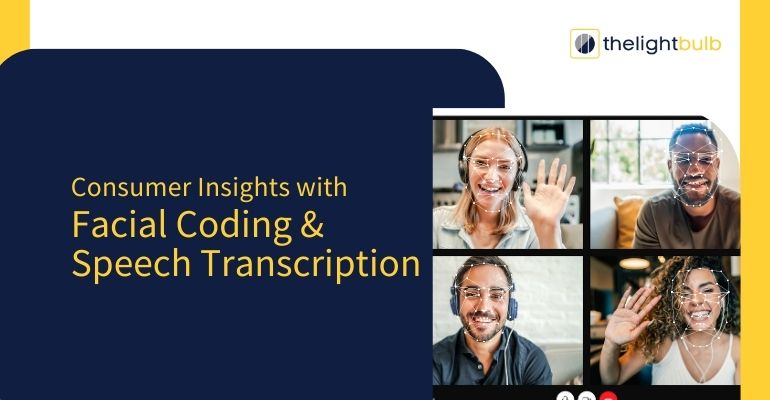
Facial coding captures facial muscle movements known as action units. Each action unit corresponds to specific emotions, and the Facial Action Coding System (FACS), developed by psychologist Paul Ekman, assigns codes to them. AI recognises the six universal expressions: happiness, sadness, anger, surprise, fear and disgust. It also recognises the many nuanced expressions beyond them. The result is an emotion curve showing exactly when consumers feel delighted, confused or bored.
2. Tracking Attention with Eye Tracking
AI shows what consumers notice first, how long they look and what they ignore.
Eye tracking produces heatmaps, gaze plots and Areas of Interest (AOIs) for ads, packaging, websites and apps. It reveals whether shoppers see a price, a logo or a call-to-action. Eye tracking shows where people look but not how they perceive what they see, which is why it works best paired with facial coding.
3. Listening to Tone of Voice
AI analyses voice tone to add emotional context to what consumers say.
During interviews and focus groups, voice modulation analysis picks up hesitation, enthusiasm, stress or uncertainty. A customer might say “It’s fine,” but a flat or hesitant tone suggests otherwise. AI-driven voice recognition also transcribes these sessions, so researchers can link each emotional signal to the exact words spoken.
4. Reading Opinions in Words and Text
AI uses natural language processing to understand opinions across thousands of reviews and comments.
NLP models map sentiment, intent and keywords for every line consumers write or speak. They uncover hidden opinions, biases and natural inclinations in customer reviews, social posts and open-ended survey answers. For example, AI can detect that “packaging” appears increasingly in negative reviews. See how AI analyzes market research data for the full process.
5. Mapping Behavior Across the Customer Journey
AI tracks how consumers feel at every step of a buying journey.
Participants move through a real journey, from browsing to comparing to checking out, while AI records their reactions through a standard webcam. The resulting emotion map shows where confidence builds and where doubt appears. What once needed a physical lab now runs online, making this one of the most valuable ways AI is used in market research.
6. Detecting Bias Between Words and Reactions
AI compares what consumers say with how they react, exposing polite or biased answers.
Emotional insights can be combined with traditional survey insights to separate honest responses from dishonest ones. If a participant rates a concept highly but shows no emotional engagement, AI flags the mismatch. This helps businesses avoid decisions based on socially desirable answers that don’t reflect real behaviour.
What Can AI Reveal About Consumer Behavior?
AI reveals emotional triggers, attention gaps, friction points, hidden preferences and early shifts in sentiment.
- Emotional triggers: The exact ad moment that sparks joy or disinterest.
- Attention gaps: Key messages consumers never notice.
- Friction points: The website step where users hesitate or leave.
- Hidden preferences: Product features customers value but rarely mention.
- Sentiment shifts: Early changes in how people talk about a brand.
These are exactly the insights AI market research helps businesses discover.
How Businesses Use AI Consumer Insights
| Industry or Team | Behaviour Question | How AI Answers It |
| FMCG brands | Does our packaging stand out? | Eye tracking on shelf designs |
| Advertising teams | Which ad scene works best? | Second-by-second emotion curves |
| E-commerce | Why do buyers abandon carts? | Journey emotion mapping |
| Media companies | When do viewers lose interest? | Engagement and distraction tracking |
| UX and product teams | Where do users get confused? | Eye tracking plus facial coding |
See who can benefit from AI for market research for a full breakdown. These questions also span the many types of market research AI can support.
Combining AI Insights with Traditional Research
AI consumer insights work best alongside surveys and interviews, not in place of them.
Surveys capture what consumers think and say. AI adds how they feel and where their attention goes. Together, they give businesses a holistic view of behaviour that neither method delivers alone. This combination is how AI improves qualitative and quantitative market research, and it is one of the most important benefits of using AI for market research.
Limits and Ethics of Using AI to Understand Consumers
AI measures reactions, but humans interpret motivation. Consent and privacy are non-negotiable.
AI can show that a consumer felt confused, but a researcher still needs to explain why. Businesses should avoid over-automation and keep experts involved in interpretation. Participants must know what is being recorded and give clear consent, and data should be handled under recognised data protection standards. Using representative participant panels also ensures that insights reflect the real target audience.
How TheLightbulb.ai Helps Businesses Understand Consumers
Insights Pro, TheLightbulb.ai’s Emotion AI research platform, combines facial coding, eye tracking, speech transcription, voice tone and text sentiment analysis to reveal unstated consumer responses.
Insights Pro helps brands and research agencies see both what customers say and how they truly feel. Its generative AI tools cut analysis time by up to 60% and create reports tailored to each stakeholder.
TheLightbulb.ai was named MarTech Startup of the Year 2024 at the BrandWagon MarTech Summit and was a finalist for the YES Awards at ESOMAR Singapore 2024. Explore AI-powered market research, or book a free 30-minute live demo.
FAQs
Can AI read customer emotions?
Yes. AI reads customer emotions through facial coding, which analyses facial muscle movements, and through voice tone analysis. Together, these show how customers feel while viewing an ad, product or website.
How does AI predict consumer behavior?
AI predicts consumer behavior by finding patterns in emotional reactions, attention data, survey answers and text sentiment. These patterns show which ads, designs or experiences are likely to drive positive responses.
Is AI better than surveys for understanding consumers?
AI doesn’t replace surveys. It completes them. Surveys capture what consumers say, while AI captures how they feel and where they look. Combining both gives the most accurate view of consumer behavior.
What emotions can AI detect?
AI can detect the six universal emotions: happiness, sadness, anger, surprise, fear and disgust. It can also pick up nuanced expressions such as confusion, interest and engagement, using the Facial Action Coding System.
Is using AI to study consumers ethical?
Yes, when it is done with consent. Participants should know what is recorded and why, and their data must be protected under data protection standards. Ethical platforms never collect data without clear permission.
Can small businesses use AI to understand their customers?
Yes. Webcam-based AI research tools run online without expensive labs. Small businesses can test ads, websites and products with real consumers and understand their reactions at an affordable cost.
Conclusion
So, can AI help businesses understand consumer behavior? Yes. By reading facial expressions, attention, voice tone and text, AI reveals the unstated emotions behind customer decisions. Combined with surveys and human expertise, it gives businesses a clearer and more honest picture of their customers. To explore the full technology, read our complete guide to AI in market research or book a live demo of Insights Pro.